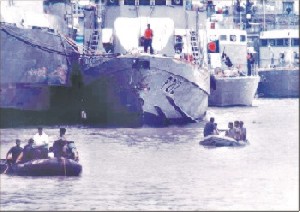
Chittagong port: Under the spotlight
A. S. M. Nayeem
Chittagong port is the main gateway of Bangladesh through which 85 percent of the sea-borne trade of the country moves. As such its importance in the national economy is paramount. The port needs to be efficient, productive and cost effective so that we can compete, survive and flourish in this age of globalisation. Multiplicity of problems
We often experience a multitude of problems while availing of the Chittagong Port facilities. The problems are mainly operational, resulting in low productivity and high cost of port activities. The tip of the iceberg is that the vessel and container turnaround time is very high, thus pushing up the operational costs of the shipping companies. Such cost inefficiencies ultimately increase the costs of our export and import, nay the economy. The main operational problems that we often experience are the following:- Over-capacity handling: Chittagong Port is working much beyond its handling capacity. It does not have the adequate and modern infrastructrural and equipment facilities to efficiently cater to the requirements of our sea-borne trade. There is a huge supply-demand imbalance. The under-capacity and under-equipped supply facilities of the port adversely affect the productivity and operational efficiency, resulting in delay of vessels and container / cargo handling, cost escalations and increased handling and shipment time. Low productivity: The average productivity of Chittagong Port in July 2003 was 175 moves per container vessel per day. This reflects a very low productivity. To compare, in the same month Kolkata had 220-240 moves/day, Cochin 225 moves/day, Mumbai 295 moves/day, Karachi 254 moves/day. High turnaround time: Though over the years the average berth-stay time of the container feeder vessels has decreased due to the positive effects of learning curve and CPA's (Chittagong Port Authority's) increasing priority on the container vessel handlings, it is still very high compared to other ports of the region. Presently the average turnaround time of container vessels at Chittagong Port is 5/6 days, which is very high by any standard. Reduction of turnaround time is important from cost point of view. Each day costs a container feeder vessel between US$5,000 to $10,000. Lack of farsightedness: Though over the years container throughput in Chittagong Port has grown substantially, the number of berths and the container storage yard / area have hardly increased. Container growth: There has been an average growth of 13percent per annum in the number of containers handled at Chittagong Port during the last few years. Berth facilities-impasse: Chittagong Port has only three purpose-built container berths, which have been there for over a decade. They are also using three (sometimes more) general purpose berths to handle container vessels. There is obviously a functional difference between a purpose-built berth. Surprisingly during the past few years government and CPA have not taken prompt and realistic steps for building up new container terminals to cater for the increasing growth of container traffic. Private off-docks: a bridge between growth and impasse: In the last few years a number of private off-docks have come up to cater for a very substantial part of storage of empty containers and stuffing of export containers. In this respect, CPA, Chittagong Customs, National Board of Revenue (NBR), Bangladesh Export Processing Zones Authority (BEPZA) and the private entrepreneurs really deserve appreciation and credit for the bold, right and timely steps they have taken. Had there been no off-docks, Chittagong Port with its present infrastructural facilities would have miserably failed to cater for the import and export growth and requirements of the country with horrifying consequential effects on our international trade and domestic economy. Handling equipment problems: CPA owned/leased equipment, prime movers and trailers are used for moving containers/cargo from and to the vessel hook points and for stuffing and unstuffing. Private equipment are hardly allowed. CPA does not have modernised handling equipment, like gantry cranes and RTGs / trans-trainers which, if installed, could substantially push up the productivity of vessel and container handling operations. CPA lacks in some special purpose cargo handling equipment and heavy lift equipment for container handling. For example, CPA does not have the required equipment for discharge of the over-weight (over 30 tons) containers. As such CPA insists on the Shipping agents / Main Line Operators (MLOs) for making their own arrangement at their own risk and responsibility to discharge such over-weight containers. System loss: We have experienced dock workers, but their attitudes, priorities and political / union polarisation deter their efficiency and productivity. They also need greasing for speeding up; and greasing costs money. In addition, there is always a system loss of at least three hours every day, because of late start and early finish of port equipment operators and labour gangs. As per shift timing we have 22 hours of operational time. So, practically speaking, round-the-clock port operation effectively means 19 hours of operation, i.e., 79 percent utilisation in normal situation. Other operational problems: The following problems add fuel to the fire:- (i) Night navigation at full stretch is not available; (ii) Insufficient buoy in the navigational channel; (iii) Docking of the Naval crafts/vessels in the port channel; (iv) Absence of dredging of the channel and jetty front on regular basis; (v) Absence of VTS (Vessel Traffic System). Security problems: We sometimes hear about pirates attacking vessels at the outer anchorage, pilferage of cargo while in port custody, and at times (though rare) even physical attacks on the foreign sailors inside the port premises. All these erode the image of Chittagong Port in the eyes of the foreign ship Owners. Result is reluctance to call Chittagong Port or addition of a risk premium to freight/charges, specially in the case of break bulk vessels or charter hire. Bureaucratic problems: Lengthy Custom formalities for clearance of import, inadequate auction facilities coupled with CPA and Customs bureaucracies, age-old law and regulations and lack of co-ordination between CPA and Customs also contribute towards operational slowdown and pushing up of cargo handling costs. Due to lack of clear-cut guidelines, the "authority-responsibility" matter occasionally oscillates between CPA and Ministry, particularly depending on the desire of the Ministry. As a result, policy decisions suffer at the field level, adding to the miseries of the port users (particularly shipping companies), with consequential decrease in management and operational efficiency of CPA and port users. Problems: Government, the major contributor
If we look beyond the surface of the port problems, we find the government and the bureaucracy to be the major hurdle arresting the smooth operation of the port, which is very much a government controlled sector. International trade is driven on business and commercial considerations where time and cost are key factors. But to the much detriment of our trade and economy, government has failed to build, develop and equip the Port facilities to meet the challenging requirements of our foreign trade due to red-tapeism, indecision, slow decision, knowledge gap and lack of farsightedness. What is required is the right vision, pro-business action plan and effective and timely implementation of the same. Inefficiency: A case for privatisation
In order to address the operational efficiency problems of the port, we should go beyond the realm of operation and talk about ownership, management and operation. It may be prudent to privatise the operation of the port as much and as fast as feasible. One way of privatisation, which has already started, is by moving the cargo and container handling activities to the private off-docks. Presently the private off-docks are storing empty containers and stuffing export containers only. The services of private off-docks may be increased by allowing them to handle FCL (Full Container Load) import containers also. This will automatically lead to privatisation of a substantial part of the port activities, in terms of ownership, management and operation. In the long run the port may restrict its activities to vessel handling, non-containersed cargo handling and LCL (Less Container Load) containerised cargo unstuffing. CPA may even think of privatising a substantial part of their equipment operation like prime movers, trailers, fork lifts, etc. by allowing the direct users to operate their own hired equipment on some realistic basis. Of course, this policy should be taken after proper examination. And a realistic modus operandi should be framed before opening the doors of such privatisation so that the port activities do not become a prey of chaos, confusion, congestion and indiscipline. CPA may even consider giving the security services of the Port premises to the Private Sector. In due time the government may consider converting the New Mooring Project into a public quoted company, having a legal entity separate from that of CPA. The management should be completely independent and run professionally. The operator should be given a free hand to employ labour and stevedores of their own choice. No Union should be allowed in that company, instead labour and employee welfare committees may be allowed to represent their interests. Privatisation of port services will be in line with the over-all government policy that the private sector should work as an engine for development and the government should work as a facilitator. Recommendations
Since the problems of Chittagong Port are multidimensional, we have to take a number of steps involving a wide spectrum of activities in order to improve the situation. These are as follow:- Objective of CPA: CPA is a basic service provider, and it is important that it gets its objectives right and tunes its mind set accordingly. Its objective should focus on providing the required services to the port users efficiently and effectively, and at competitive prices. CPA should plan and take action, guided by the above objective. New mooring project: Presently CPA is seriously considering construction of a 1000-metre berthing facility with gantry crane facilities and with a back up space of 60 acres in the New Mooring area. With an honest desire, seriousness and sincerity of the government and CPA, the project can be completed and made fully operational within a period of 3/4 years having 4 to 5 container berths. Adding with the present three purpose-built container berths, the total purpose-built container berths will then be increased to 7/8 which, together with the private off-docks and blessed with pragmatic policy instruments, can adequately cater to the requirements for handling container vessels and cargo for a period of another 15 years or so. Equipment modernisation: Chittagong Port needs further improvement in its cargo handling capacity through the installation of increased number of modern operational equipment. As an immediate measure, it is felt that CPA may consider providing gantry crane facilities at the present three container berths which will substantially enhance the efficiency and productivity of container handling operations and reduce the vessel and container turn-around time in the near future. Further, Chittagong Port can increase its container handling capacity significantly by using RTGs / Trans-trainers instead of Straddle Carriers and by switching from the existing three tier system to 6 to 7 tier system at least for empty and light weight containers. Direct discharging/loading: CPA may consider allowing direct discharge of EPZ-bound FCL import containers from vessels and direct loading of FCL containers stuffed in EPZs, off-docks and Dhaka ICD as much as feasible. This will reduce pressure on the storing yards and thus ease out congestion. Manpower management: The first and foremost task of the CPA should be to improve the quality of manpower engaged in the Port activities, starting from the top man down to a petty worker. It is a team effort, and weak/bad players of the team should be weeded out through effective manpower management. And this is a challenge that the government, CPA and the Unions have to collectively and successfully meet. Private off-docks: Off-docks should be seen as an extension of the port facilities. CPA may take a policy for not storing empty containers in the port premises beyond 21 days and reduce their lift-on and lift-off charges to encourage empty removals from the port to the off-docks. CPA and Customs Authority may also consider allowing FCL import handlings in the private off docks. Simplification of procedures: The customs and port procedures, particularly for import, should be simplified, and the decision making chain in this respect should be curtailed. As a simplification measure, the Port and the Custom authorities should introduce computer on-line connections with the main port users like shipping agents, C&F agents and stevedores, and install necessary softwares for transmission and exchange of the required information and data. The custom auction sheds should be increased, and auctions should be expedited to ease congestion in the port. There should be a Port Operation Committee comprising of Custom and CPA officials and representatives from port users in order to ensure smooth operation by untieing the procedural knots that may crop up from time to time. Decentralisation of authority: CPA should be given more freedom to run their affairs independently and efficiently within the policy framework to be given by the Ministry. Concluding remarks
In order to facilitate economic growth, the government should immediately give due importance to the port sector and take appropriate action so that the efficiency and productivity of Chittagong Port improve significantly, and Chittagong Port is no longer branded as one of the most expensive ports in the world. It is impossible to do it overnight. But let the government take it as an agenda for a 5-year term, and let work on today as well as on tomorrow. We can then hope to see Chittagong Port changing from bud to bloom in the days to come. A. S. M. Nayeem FCA, a Chartered Accountant, is currently a Council Member of the Institute of Chartered Accountants of Bangladesh and a Vice President of the Chittagong Stock Exchange Ltd. He was the immediate past Chairman of Bangladesh Shipping Agents' Association and of Port Users' Forum
|