Endeavour
Mary Wilson empathises with the under-privileged
Former Supremes-vocalist visits Bangladesh with 'Dare to Dream' project for cross-cultural understanding
Afsar Ahmed
Although music will always be her primary focus, Mary Wilson--the former vocalist of the band The Supremes--enjoys spreading her creative wings in other areas too. Singer, actress, author of two best-sellers, humanitarian, tireless spokesperson and activist for causes including breast cancer, research, domestic violence, AIDS and cystic fibrosis, Mary Wilson always uses her talent to make the world a better place. In continuation of her role as the cultural ambassador, she was here to motivate the poverty-stricken Bangladeshi children and promote her 'Dare to Dream' project. This project is a part of the US State Department initiative, known as CultureConnect, which promotes American culture 'beyond the stereotypes.'Sharing the Dream with the slum children
In the morning of March 17, Mary Wilson--in a black pantsuit and a straw hat--visited a school for the adolescent brick chippers at Gabtoli. The school is run by a local voluntary agency, the Centre for Mass Education in Science with funding from UNICEF. The children of the school, sitting under a canopy in the yard of the tin-and-brick schoolhouse, greeted her with great ovation and flower bouquets. 'Your pure and innocent eyes reveal your hearts', said the amused singer to the children and took photographs with them. 'I know you work very hard,' Wilson told her newest fans. 'When I was young, we were very poor and my family had to work very hard at the cotton plantation. But I grew up to be a rich lady. We dared to dream to make lots of money so we could get out of poverty. You have to dream so that you too can be big,' she told the children. 'Swapno Dekho', she emphasised in Bangla with the help of an interpreter. Then Wilson sang popular Supremes' hits such as You can't hurry love and Baby love, and although the children did not understand the meaning, they enjoyed the tunes and joined in by clapping. When Wilson apologised for not knowing their language, Bangla, the children put on a show for her--singing popular songs, including a local version of the US civil rights song, We shall overcome and also presented a play. Later, Wilson went to ABC School in Bashundhara, an institution for deprived children. The principal of the American International School, Dhaka, Dr. David Fussell, and his wife, provide the financial support for running the school. There too, Wilson sang and talked to the children and had great fun. A momentous musical evening
The long awaited evening rolled up when Mary Wilson, in a sequinned midnight blue gown, made an extraordinary appearance at the Osmani Memorial Hall. The concert was divided into three parts--the opening selections from Wilson's favourites, the slide presentation of Dare to Dream accompanied by Wilson's narration and the closing selections from her favourites. You can't hurry love, Where did our love go?, Someday we'll be together, Stop in the name of love, Baby love, Reflections were some of the most popular renditions of the evening. She enthralled the audience with her vibrant voice rich with emotion and fire. Wilson quickly developed a rapport with the audience with her lively banter, dedicating some of her songs to the Embassy staff, diplomats, and others. Later she invited some members especially 'older teenagers like her' from the audience to join her on stage to sing one of the Supremes' signature songs. After the show the fans besieged her for autographs. Rendezvous with the legend
The minute the concert ended I felt edgy as I had waited long for a meeting with the legend. After the show, three of us (reporters) were taken back stage for an exclusive interview. At last she entered the room completely exhausted after a hectic day. Asked about her impression and overall experiences in Bangladesh, she said, 'The people here are very warm-hearted, congenial and welcoming. But two days is really a short time to get acquainted with Bangladeshi culture. I hope to know more about it on my second trip.' 'I came here to inspire and motivate the deprived slum children. I had the same background and I never gave up my dreams. I got the feeling that we understood each other.' Mary Wilson was chosen as a Cultural Ambassador because of her successful singing career as well as her dedication to helping young people. Whatever artistic venture she pursues, she never forgets her roots. 'Dreams do come true. I live by the philosophy that dreams don't die; although people do stop dreaming', she ended.
|
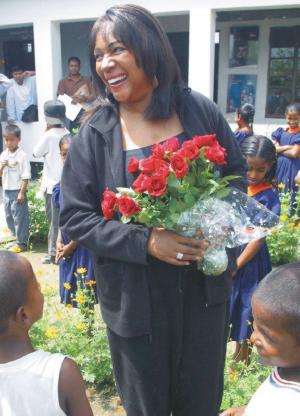
Famous American singer Mary Wilson with under-privileged children at ABC school.Photo:Pavel Rahman |

