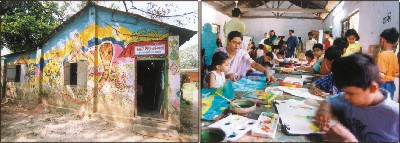
Fading colour of Shilpacharya’s dream
Children’s art school, set up by Zainul Abedin in 1958 at the Institute of Fine Arts, limping
Sabrina Karim Murshed
Engrossed in expressing their impression, they add colour to their dreamscape. With every stroke on paper, at least 125 children at Zainul Shishukala Niketan, give forms to their creativity, but the art school is not as upbeat as they are. It is reeling from shortage of fund and spaceThey come to school on the leafy campus of Institute of Fine Arts to pick up painting skills, making it come alive with fun and frolic every Thursday evening and Friday morning. "The serene atmosphere here attracts me a lot. I can work on my painting without diversion," says Tirtha, a student of class VII, who has attended art school for six years. His art classmate Samay Subandhu Barua says the open space on the school premises is an additional attraction to the kids. "We can play around here." Authorities say they run short of fund and the school cannot accommodate more children as they lack space. The schoolroom is so small that the authorities put up a notice asking guardians not sit with their wards. "We feel bad about it," said Professor Abul Barq Alvi in charge of the school. The school began in a single thatched room in 1958 with the initiative of Shilpacharya Zainul Abedin and was named "Shishukala Bhaban". "The room was built as a warehouse to keep construction materials of the fine arts building," Professor Alvi said. Shilpacharya decided to create an opportunity for kids to learn art and over the years, concrete walls and a tin roof have covered the schoolroom. Sources said Children's Welfare Council began supervising the school in 1960 and it was then named "Shamsunnahar Shishukala Bhaban". The council also funded the school that received stationery like paper, pencil and crayons from Unicef (United Nations Children's Fund). Fine arts teachers took it over around 1980 and renamed it "Zainul Shishukala Niketan", as the council could not maintain it properly. The school provided children with free art-coaching until 2000. A student now pays a tuition fee of Tk 100 a month and Tk 200 in admission fees. "We cannot raise the tuition fees as we want to keep it within the easy reach of people," Prof Alvi said. Sometimes the teachers and guardians bear some expenses or donate necessary items such as table or fan. "We could not appoint more teachers because not everyone will work without pay," Professor Alvi said, adding five teachers work for the school without salary. Most guardians believe the school gives an opportunity to the kids to nurture their finer qualities. They say the urban children do not get enough time and space for recreation. "Other art schools in the city teach students how to paint a specific picture following the teacher's instructions but here students paint whatever they wish," said Susnigdha Barua, mother of a six-year-old son. The school authorities say they want the students to grow on their own and try to provide room for them to express their innate quality. "We only inspire them," Prof Alvi said. He says the school insists that its students take part in art competitions to shore up their confidence. The authorities say they need a monthly fund flow from a donor to allow the school to grow.
|