Tightening grip on easy access to corrosive acid
Avik Sanwar Rahman
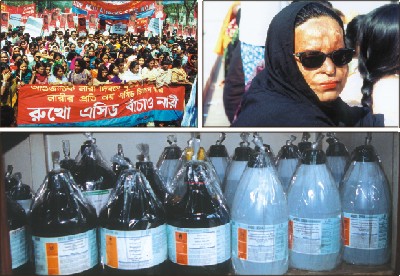
The government has finally woke up to tighten grip on the chemicals that have often been used as a tool for revenge attacks.The National Acid Control Council (NACC) at a meeting last month finalised the draft of the Acid Control License Rules and it now awaits the law ministry's approval. The NACC meeting was attended by representatives from the ministries of law, health and family planning, women and children affairs, Khan Foundation, Acid Survival Foundation (ASF) and chairman of the Department of Chemistry of Dhaka University and president of the National Press Club. Immediate past Home Minister Altaf Hossain Chowdhury chaired the meeting. The license rules have been tightened to put an end to uncontrolled access to acid under the Acid Control Act 2002. At the moment acid producers, distributors, carriers and consumers do not require license to conduct business. "Licensing will help restrict availability of acid and will minimise the risk of corrosive chemicals getting in to the wrong hands," said a member of the NACC. According to the rules, the Ministry of Commerce will issue licence to importers, producers, distributors, wholesalers, retailers and carriers. Consumers will have to get their license from the District Commissioners. The importers will have to pay Tk. one lakh, producers Tk. 1.5 lakh, commercial wholesalers Tk. 25 thousand and retailers Tk. five thousand for an Acid Control License. Consumers have to pay a permit fee of Tk. Three thousand for up to 10 litre acid and Tk. seven thousand if the quantity is more than 10 litres. Sulphuric and nitric acids are usually used in attacks. As the jewellery and leather industries use these acids for washing, the criminals have easy access to them. It is also not difficult to procure acid from other intermediaries of this business. "The rules may restrict availability but it will not eliminate the risk altogether because there are many clandestine businesses that use acid and don't even have a trade license," said Monira Rahman, executive director of ASF. An ASF study has observed that people of all ages and sex are vulnerable to acid attacks in our country but women between 18 to 45 years of age constitute the highest number of reported victims. An AFS research reported that acid attacks have seen a rise in recent times. In the year 2000, there were 222 victims while in 2003, the numbers shot up to 410. This year, 62 persons have already been attacked till March. The members of the NACC demanded that those charged under the Acid Crime Control Act 2002, should face trial by the Speedy Trial Tribunal. The council also launched the National Acid Control Fund for creating social awareness and treatment for the acid victims.
|