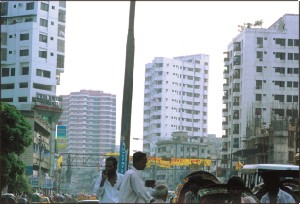
Illegal pumps add to water crisis in city
Sultana Rahman
Majority of homeowners, especially of high-rise buildings, have installed illegal water pumps causing serious disruption to Water and Sewerage Authority's (Wasa) distribution process and create acute scarcity during the dry season.The use of pumps in apartment buildings, high-rises, commercial and industrial structures have become an open secret and some small houses have them for sucking water. Sources claim that a number of dishonest officials and meter-readers at Wasa's different zones are responsible for this practice flourishing as they often turn a blind eye taking bribes from the owners of the buildings. Officials say that as a massive quantity of the underground or surface water is pumped away into the reservoirs of the high-rises and apartments, the demand in the capital reach crisis stages in summer. Wasa reportedly incurs a daily shortfall of nearly 15 crore litres. According to Public Demands Recovery (PDR) Act, if any building owner is caught pumping water illegally, Wasa is empowered to disconnect the supply line temporarily or permanently. But residents suffering from shortage allege that the law is on paper only and is hardly ever applied. "We have only one magistrate to implement the act for some 2.16 lakh consumers. Is it feasible to take action against almost the entire group of homeowners as 80 per cent of them have illegal pumps" asked managing director of Wasa ANH Akhter Hossain. "This situation has evolved over a long period. But now we are aware of it and planning to introduce a model to generate and distribute water under the mathematical equal system," said Hossain “Dhaka now holds hundreds of high-rises, apartments, commercial complexes etc. and the city is growing vertically everyday. More and more people are living or working at these places and building owners in their bid to satisfy the tenants have no option but to install water pumps which are illegally linked to the authorised water supply line of Wasa,” said another senior official. Many apartment owners also do not disagree. "I am unable to cope with the water requirements of my tenants if I do not use the pump. Whatever I get from the Wasa line is consumed within an hour," claimed an apartment owner of Dhanmondi. A Wasa official said that illegal pumps were one of the major reasons for the groundwater level dropping by around 24 meters since 1996. Wasa estimates that approximately 2.16 lakh clients are buying water from it but the number should have been 3.50 lakh as per the holding list of Dhaka City Corporation (DCC). The demand for water is 160 crore litres a day in Dhaka city but the Wasa is able to supply only 145 crore litres. It provides water to city dwellers through the Sayedabad Water Treatment Plant, three water treatment plants near Narayanganj and 412 deep tubewells, 230 of which have fixed generators. "Many areas face severe shortage of water due to the erratic electricity supply. People in Mirpur, Gulshan and Baridhara are the worst sufferers and their plight is compounded when most of the high-rise owners pump out huge volumes of water in the dry season," said a source at Wasa. "The water supply woes worsen when electricity goes off for a long period of time. The introduction of the mathematical model and metered monitoring will improve the situation a lot," believed the managing director of Wasa. He informed that Wasa would begin a survey to measure the uniformed and artificial pressure on different transmissions in the city. An independent consultant will be employed to conduct the survey and after it has been a completed, all illegal connection and people involved in unauthorised pumping will be identified. "We will go for action very soon against the householders who have illegal pumps," Akhter Hossain assured.
|