Celebration
Baishakhi carnival at Sunbeams School
Students present an impressive show
Kavita Charanji and Afsar Ahmed
Shubho Noboborsho--the parents, children and teachers greeted each other for the Pahela Baishakh at Sunbeams School recently. Both the junior and senior school staged cultural shows, which are a feather in the cap for this well established educational institution. The junior school turned into an aarong (village fair) where terracotta vied for place with children's toys, glass bangles, nagordola (Ferris-wheel), and traditional foods such as pitha, ghol, lime water, luchi and bhaji. Traditional sweets like batasha, kadma, naru and hawai mithai--new delicacies for the city kids--sold like hot cakes. Even the alta and henna corner was crammed with the young girls and their mothers.The cultural events of the junior school were well appreciated. Seleena Mustafa, extra-curricular activities in-charge gave us a vivid idea of the function and said, 'This kind of festival will help our students to learn traditional values.' Dressed in traditional red and white saris and colourful kurtas with brilliantly painted faces, the little children began the morning with the famous Nazrul Sangeet Tora Shob Joyoddhani Kor and other songs of nature. The last performance by the children was Tagore's popular Baishakhi song Esho Hey Baishakh. As soon as the programme ended, the children ran off to the nagordola and enjoyed the day. Watching the function of these young children, was Nishat Nawal, a parent of a nursery child. In her words: 'This is a special day which children love to celebrate with their friends.' The senior section of Sunbeams School also presented a cultural programme. Leena Kabir, the Bangla teacher, gave the welcoming speech and reiterated the importance of this day. With their rendering of Bartho Prener Aborjona, a notable Tagore song, the students ushered in the new year. Some of the notable items were Megh bihin khoro boishakey by Uzma Samad, Amar Je Shob Dite Hobe by Zaariyat and Tahsina and dance performances on several popular songs. Other highlights of the day were recitation of poems by Tagore and Shukumar Ray. The latter half of the programme was based on the open stage concept. Through this medium, the students showed their talent in songs, dances, recitation and acting. They also rendered Rabindra Sangeet, Nazrul Sangeet, Gano Sangeet. Other features were patriotic songs and songs of the yesteryears. A highlight of the programme was the fusion dance by the girls on some popular tunes like Krishna Ailo Radhar Kunje and Swadher Lau. Enjoying the cultural show, veteran actress and cultural activist Ferdousi Majumder, who also teaches Bangla in the school, welcomed the new year by playing dugdugi with her fellow teachers and students. Outlining the objective of this festival, Niloufer Manzur, chairperson of Sunbeams School, says: 'Today, all Bangalis irrespective of religion--come together to celebrate this festival. This is one occasion which crosses all barriers. In that sense Pahela Baishakh is an apolitical festival.' The students are equally enthusiastic about this day. Says Zayeema Sarwar, a student of Class Eight: 'We look forward to this festival the year round.' Older children like Samera and Tanjeb, O level students who are to go to India and Venezuela respectively for further studies, give their perspective on the new year. They say they enjoy this festival better than that observed by the West. To quote them: 'We have a course in our school called Bangladesh Studies. This subject helps us to get acquainted with our own traditions.' Clearly, the younger generation has lost none of its enthusiasm for Pahela Baishakh. It is heartening to know that despite being swamped by western culture, a whole new generation in Bangladesh will observe this festival with verve in the years ahead.
|
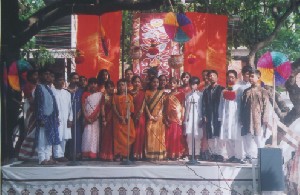
Young performers clad in colourful Bangali outfits presented a lively cultural show |

