Rationale for independence
Filling the gaps in facts and interpretations
Mahfuzur Rahman
Many years ago, a Pakistani colleague in an international organization I worked for was reminiscing how he travelled around Dhaka and other places of the then East Pakistan in the 1960s and could see only a few forlorn signboards of industrial enterprises but no industries. Then he said to me, "Now I realize why you wanted separation from Pakistan." Today I wonder how many people in Bangladesh care to remember or know why. To many minds, it looks as though the birth of the country has no history at all. The void in perceptions of the political struggle that led to the emergence of Bangladesh is large; it is even larger when it comes to understanding the economic realities that underlined the struggle. Making of a Nation is a major contribution to the filling of the latter void. And it achieves much besides. The genesis of discontent from the unequal partnership between the two wings of Pakistan can be traced to the mid-1950s, not long after the beginning of the language movement early in the decade that proved to be the first step to Bangladesh statehood. The story is told in fascinating detail by Nurul Islam, eminent economist, former professor at Dhaka University, Director of the Pakistan Institute of Development Economics, Deputy Chairman of Bangladesh Planning Commission, and Assistant Director-General in the Food and Agriculture Organization of the United Nations. Dissatisfaction with the creeping pace of economic development of the eastern wing of the country found its first academic expression in a report of a conference of East Pakistani economists organized to elicit views on the first Five Year Plan (1956-1960). The report of the conference, held in August 1956 and reproduced in the book, called for the need to conceive of the economy of Pakistan "as consisting of two economic units" for purposes of development planning, while recognizing that "for certain purposes, for example, mobilisation of internal and external financial resources, the country could be considered as a single economy." The report not only emphasized the concept of two economies for the purpose of accelerated development of the eastern wing, but also spelled out the first steps to its implementation. The signatories of the report included noted economists of the time, Nurul Islam among them, and almost all of them my teachers at Dhaka University, where I had finished my post-graduate economics the year before. The slim report, and later work by economists on the questions of "two economies" and economic disparity between the two wings and subsequent political developments so well described in the book, reminded me once again of the famous saying of Keynes: "[The] ideas of economists and political philosophers, both when they are right and when they are wrong, are more powerful than is commonly understood. Practical men, who believe themselves to be quite exempt from any intellectual influences, are usually the slaves of some defunct economist." From that point on, things moved faster and farther than is usually perceived. Soon after assuming power in a military coup in 1958, Ayub Khan turned his attention to economic development of the country. The Field Marshal must have been hugely amused in his private moments by the Bengali economists' arguments when they reached him. But he did meet some of these economists and heard them out. On his suggestion, a small group of economists, which included the author, submitted a memorandum which again elaborated on the rationale of treating the economy of the country as two economies. No more was heard of the memo. But the arguments were kept alive and elaborated in various forms in a number of forums: in the Price Commission of 1960, for example, the two Finance Commissions (1961 and 1964), the East Pakistan economists panel on the Fourth Five Year Plan, in all of which the author was involved, and at individual and institutional levels. Disparity was measured and the flow of real resources from the eastern wing of the country to the west was quantified, often using relatively simple macroeconomic relationships, and argued about. The book well describes the work of Bengali economists in the field and their efforts to gain the establishment's acceptance of their arguments to eliminate disparities. Their goal was also to raise public awareness of the issues involved. There is of course no suggestion that the economic destiny of the province lay in the hands of economists and Nurul Islam deflects himself from any such idea. In a major chapter of the book he elaborates the Awami League's Six- Points Programme, one of the most important landmarks in the political process that finally led to the emergence of Bangladesh. Although the fundamental objective of the Programme can be simply stated as one of preventing the west from exploiting the east, the institutional arrangements to achieve that objective were highly complex and were meant to end the west's established privileges. The west did not have the political will to accept such arrangements. The chapter makes an important contribution to the understanding of the Programme and the political battles that raged around it. The author' story of exile after the military crackdown of 1971 is an interlude that is interesting to read but the tale of efforts at nation building begins soon. It is a long story. From a distance of almost three decades, the history of Bangladesh in the first three or four years of its existence has often seemed to me, and possibly to others who have lived through it, a view through the wrong end of a telescope: a huge diversity of events, actions and actors, as well as problems, promises and possibilities, all collapsed into a tiny length of time. This is true even when we restrict ourselves to economic history. The problems of rebuilding and development were enormous. There was no well defined path to tread. In over half a dozen core chapters Nurul Islam treats many of the major events, as well as many of the issues that faced the new nation, and action taken to tackle them. The dilemma over whether a programme of reconstruction and rehabilitation, rather than a plan for long-term development should not have priority; the setting up of the Planning Commission, headed by the author, and its functioning; the formulation of a Five Year Plan that was supposed to reflect the sociopolitical framework of the constitution; the extent of the political commitment to the Plan; the debilitating tension between the bureaucrats and the "Professors" of the Commission; Plan priorities; the question of nationalization of industries and banks; economic relationships with India, the country's big neighbour and ally in the liberation war; aid relationships with western donors, both multilateral and bilateral; the famine of 1974; and many more, crowd the pages of the book. They make compelling reading. The final chapters of the book go beyond history, bring in questions of economic policy reform, and offer important insights into issues of the relationship of Bangladesh with its big neighbour on the one hand and its (unequal) partners in development in the western world on the other. There can certainly be differing interpretations of the historical scenes presented. Rashomonesque perceptions of the same event are always possible. But to the present reviewer many of the events and issues described in the book and much of the analyses clearly ring a bell, or a series of it. Even where the descriptions tend to be tedious or contentious, they are useful. In the process of presentation of history, the author also debunks some of the popular misconceptions about some of the stances of the government of the time that have been kept alive over the years. The author's sojourn through memory lane, made in a separate chapter, as well as titbits served elsewhere, does enliven the tale and should tickle readers weary of details of weighty issues. The personal relationship between the author and Sheikh Mujibur Rahman is described as being correct and based on mutual respect. There are interesting accounts, told for the first time, of the author's private encounters with his leader. More interesting should be the never-told-before snippets, for example, on the relationships between Sheikh Mujib and Mushtaque Ahmed, his nemesis. And how many people know that Tajuddin Ahmed, then Finance Minister, told Robert McNamara, the World Bank President, in no uncertain terms that what Bangladesh needed immediately was bullocks for tilling the land, and not fancy ideas from the Bank? We are grateful to the author for such insider stories. He sometimes leaves in the nook of anonymity some of the personalities whose actions he describes or comments on. This may be mildly infuriating to some; others may actually enjoy connecting the dots. The book is some 500 pages long. There is an attempt at comprehensiveness, which is perhaps not always a virtue. It was achieved, in a number of places, by delving into areas quite unrelated to the main story. And sometimes it was necessary for the author to use what looked like weak pretexts to bring in a new discussion. The quote from Keynes on page 354 certainly looked so to me. But these are minor criticisms which do not diminish the great value of the book. Mahfuzur Rahman is a former United Nations economist.
|
Book Review
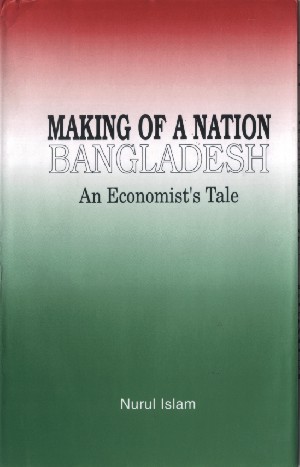
Making of a Nation: Bangladesh - An Economist's Tale
By Nurul Islam
The University Press Limited, Dhaka.
xix +482 pages |

