Scientists close to creating substitutes for blood
Bangladeshi professor leads team to discovery in Hawaii
Mustak Hossain
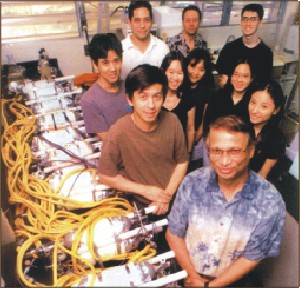
A team of researchers led by a Bangladeshi scientist has made a discovery that could lead to the creation of substitutes for blood.Maqsudul Alam, professor of microbiology at the University of Hawaii, US, said his team has discovered 'proteins containing oxygen in primitive microbes'. "We are very confident this (protein) is the ancestor of human haemoglobin," Alam said in an e-mailed interview with The Daily Star. Haemoglobin is the protein in blood that carries oxygen from the lungs to the body's organs. Haemoglobin probably was detoxifying dangerous gases and slowly evolved to transport and store oxygen for human life, he noted. "We believe that similar proteins will be found in other tissues and also in micro-organisms," Alam he said. The idea of finding 'human haemoglobin-like protein in extremophilic micro-organism was developed in our laboratory around 1999' during a series of wet-lab experiments and using computational analysis of several data bases, the scientist said. The findings now reveal what the climate was like on the planet more than 3.5 billion years ago when there was no oxygen. They also showed how respiration evolved, he added. The National Science Foundation of US announced the discovery saying that diversity of life was able to expand with the ability to use oxygen for respiration. "An impact more fundamental, if perhaps not as dramatic, as the evolutionary transitions organisms made adapting from sea to land, from the ground to the air, or from 'all fours' to upright." The discovery has created much enthusiasm among scientists in the field and many companies have proposed to carry forward the research that is expected to result in the creation of substitute for blood. Replying to a question, Alam said it is very hard to predict how long it will take to produce substitutes for blood. If everything goes fine, it might take 8-10 years here in US to complete the process from research in laboratory to clinical trial in hospitals. But some modern technologies might shorten that time considerably, he added. Alam also said his team thought they would find haemoglobin in the protein of the "last universal common ancestor," from which all life evolved. The primitive proteins, called protoglobins, were identified in two species of archaea. "We will know how the protein formed, what its property is and how we can modify and use it for different biological applications," the Bangladeshi scientist said. "Intriguing connections" might exist between the "last universal common ancestor" and the evolution of mechanisms that sense oxygen, carbon monoxide, nitric oxide and hydrogen sulphide, he observed. University of Texas Southwestern Medical Centre scientists also contributed to the research. Alam, son of martyred freedom fighter Daliluddin Ahmed and late Lirian Ahmed, had his schooling at Government Laboratory School in the capital and then studied at Dhaka College. He obtained doctorates from Moscow State University and from Max Planck Institute of Germany.
|