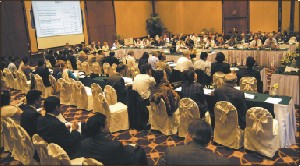
BDF Meet
Govt obliged to protect people from criminals
Donors want proper probe into political murders
Staff Correspondent
The government cannot shirk the responsibility for the killing of Awami League lawmaker Ahsanullah Master, as it is obligated to protect people from criminals, said World Bank's Vice-President for South Asia Praful C Patel yesterday. "It should not be an answer that we (the government) did not kill him," said Patel, also head coordinator of the donor community at the Bangladesh Development Forum (BDF) meet, at the Sonargaon Hotel. "The government must take responsibility and ensure two things -- properly investigate the murder and punish the criminals and inform people that such incident will not happen again," Patel said, speaking on behalf of the 32 donors. Unnamed gunmen killed Ahsanullah at a rally in Tongi on Friday, a day before the three-day BDF meet opened to review the pledges the government made earlier and highlight law and order downslide. On the second day of the meet yesterday, development partners said the government is more responsible than any other institution for improving law and order, stopping political killings or journalist repression and bringing the opposition back to parliament. At a session on Promoting Good Governance and Human Security, they expressed deep concern at corruption and weak governance. Law, Justice and Parliamentary Affairs Minister Moudud Ahmed presented the keynote speech at the session chaired by Finance Minister Saifur Rahman. Corruption and law and order downslide took centre stage in the discussion, prompting Saifur to tell the donors in exasperation: "If you have something new to tell us, say that." The donors asked for a deadline from the government for completion of reform it pledged, and observed that most pledges were not implemented and implementation of some pledges was slow. With low confidence in pledges, a European Union representative told Moudud: "You have made more promises today. When I will go back home, I will check back (with old documents) whether your speech today is the same speech you made two years ago." Bangladesh is making worse records in the corruption index by the year, the donors said, adding there is no guarantee of natural death here. "These factors prevent us from urging investors to come to Bangladesh to invest. Bangladesh is suffering from an image crisis," a donor representative said. They discussed the Chittagong Hill Tracts (CHT) situation and asked the policymakers why the government prevented CHT leader Shantu Larma from going to New York. They also said the government neither implemented the CHT peace accord nor undertook any development work. Nor did the government take steps to improve law and order there. On the repression of journalists, the donors said there was no press freedom in Bangladesh, where reporters work under threats. They also named journalists, who were killed or repressed. Moudud protested the observation and said: "It's not true that there is no press freedom. Rather newspapers misuse press freedom." The law minister produced a copy of a leading daily and said when the prime minister donated rice to tornado-hit people in a village in Netrakona, the newspaper wrote that there was no relief. Moudud claimed that journalists were not killed for journalism, but for 'other' reasons. Focussing on the poor human-rights situation, the donors asked the government why it did not set up the human rights commission yet despite commitments. On police reform, the donors cited an example of mass arrests and said many innocents were harassed in sweeps in the run-up to the April 30 deadline of the main opposition Awami League for unseating the coalition government. On the deadline, Moudud said: "It was conspiring to gather millions of people in the city. But the nation has been saved from a major conspiracy." The session over, Patel shared some discussion points with journalists. "The opposition should play a constructive role," he said. "On the other hand, the government is more responsible for making parliament more effective and bringing back the opposition (to parliament) through discussion. Because you (coalition) are now in power." It is a good idea to take account of the property and interest of the ministers to head off corruption, he said. "I believe uprooting corruption should begin at the top. We will raise this issue at the meeting." If corruption could have been reduced and governance improved, Bangladesh's GDP would have gone up at least 3 percent, Patel said. In another BDF session, Policies and Programmes to Deliver the Poverty Reduction Strategy Paper (PRSP) Goals and Millennium Development Goals (MDG), donors urged the government to prepare the PRSP through discussing with the opposition. "If the government starts implementing the PRSP without discussing with the opposition, the future of PRSP will be uncertain. Because if the opposition comes to power, it will obstruct the implementation of PRSP on political grounds," a donor representative said. Saifur told the donors: "We will place it in parliament and discuss with the opposition after the upcoming budget session."
|