Tagore evening
Tagore through the lens of Ray
Rendition of Tagore's work at Spectra Convention Centre
Afsar Ahmed
Incorporating dramatised sequences from Gurudev's ( as Tagore's disciples call him) life and archived images and documents, the unforgettable film maker Satyajit Ray captured this great soul of Bangali culture on celluloid. The 54 minute black and white documentary was made to celebrate Tagore's birth centenary in May 1961. Hence, this was an official portrait of India's celebrated poet; Ray consciously did not include any controversial aspects of Tagore's life. This rare piece of documentary film was screened at the end of the cultural programme organised by the Spectra Convention Centre to mark the 143rd birth anniversary of Rabindranath Tagore a great poet and prime mover of the 19th century Bangali renaissance.Winner of the President's Gold Medal, New Delhi and Golden Seal, Locarno in 1961 and Special Mention, Montevideo, in 1962; this film depicts a skilful and richly life-affirming composition of the original footage and collage of still images. The film begins with the Nobel Laureate's childhood and adolescence-- his private, domestic life. The sequences of young Tagore in his early ages are moving and lyrical. In Ray's words, 'Ten or twelve minutes of the film are among the most moving and powerful things that I have produced'. Gradually it unfolds his public life, emphasising the great political movements to which he contributed, which gradually led to India's independence. The original footage is drawn from the archived documents. However, a time span of 54 minutes seemed inadequate to describe the great poet. The tribute started with the recitation of one of Tagore's patriotic song Deshey deshey bhromi and his prose Shandhya o probhat by renowned cultural personality Aly Zaker. He said about Tagore ,'An artist, reaching such heights like Tagore, can prophesise the future.' Then Sushmita Ahmed rendered Tagore's songs like Shandhya holo go, Amar mon manena and others. Acclaimed actress Rokeya Prachi gave a recitation from the poem Banshiwala. This was highly appreciated by the select audience. Mita Haq performed Tagore's patriotic songs, such as Tomari torey Ma shopinu e deho, Deshey deshey bhromi and Bertho praner aborjona with her usual eloquence. Other romantic songs such as Tumi ki keboli chhobi, Amar praner manush acche praney and, Hridoyer ekul okul were also performed at the programme. After the exclusive session of Mita, actor Litu Anam recited the poem Ekjon Lok. Seasoned theatre and TV actress Lucky Enam's exceptional performance portrayed the character of Nandini from Rakta Karobi. At the end, the rare documentary on Tagore was shown. The occasion was conducted by singer Hasan Abidur Reza Jewel. Spectra's attempt to screen this documentary is indeed praiseworthy.
|
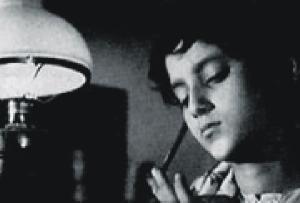
A still from the documentary |

