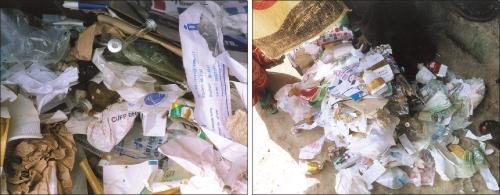
Hospital waste dumped in open, sold for reuse
Two out of three trays of DMCH incinerator out of order for years
Mizanur Khan
Waste generated by Dhaka Medical College Hospital (DMCH) puts public health at high risk as it is dumped in the open and onto the road in front of the emergency gate.Doctors, nurses, assistants and other staff of the biggest hospital in Bangladesh say the open-air dumping of waste is a routine affair. "It is true that bandage, gauze and cotton are dumped outside the hospital and that is risky," said DMCH Director Nazmul Huda. "Installation of an individual incinerator at every hospital and clinic in the city is not possible. We need two or three central incinerators where everybody can burn waste," he added. Experts say hospital waste spreads diseases both airborne and contagious. "Hospital waste such as discarded saline bags dripping with blood poses a serious health hazard," said a DMCH doctor. "Poor women and children are more vulnerable because they handle the waste with bare hands. They could be contaminated with HIV or hepatitis B and other infectious diseases." Two trays of the DMCH incinerator went out of order after it was set up three years ago to burn used gauze, bandage, syringes, blood bags, cotton, plaster, bed sheets and separated body parts. The building for the incinerator was built at a cost of Tk 27 lakh during the Awami League rule, but the valuable machine has remained almost inoperative because of fund shortage. "The service is disappointing," said a DMCH official on condition of anonymity. The DMCH installed three trays in the incinerator. Used gauze, vials, bandage, cotton, discarded foods, blood and separated body parts were supposed to be burnt in two trays, while the other was installed to burn syringes, needles, saline drips, medicine bottles and other plastic materials. "We now burn dangerous waste in one tray, as two trays are now inoperative," Huda said. Contacted, an official said the incinerator was built with the Asian Development Bank's fund and immediate repair is impossible as the DMCH runs short of fund for maintenance. Dr Masud Alam, additional director of the hospital, said the DMCH wrote to the company from which the machine was bought, asking it to repair. Sources said two workers without technical know-how were appointed to operate the incinerator: one was a bus helper and another was an electrician. "They just switch it on and off," an official said "Our hospital doesn't have skilled workers to run the incinerator. We don't have an alternative," Huda said. Medical assistants (ayas) of the hospital carry saline bags, syringes and needles in plastic bags and sell them to shops in Chankharpul. "Although the ayas collect hospital waste, some union leaders of the DMCH control the business from behind the scenes," a shop owner said. "We buy saline bags, syringes and needles at Tk 20 a kg and plastic items like PET bottles at Tk 10 a kg," said Babul Hawladar, who has been into the business over the last 20 years. According to the health ministry, there are more than 700 clinics and hospitals in the city, producing an estimated 300 tons of waste a day. But they do not have enough facilities to burn waste. Dhaka City Corporation says the city produces 4,500-5,000 tons of solid waste every day, 1 percent of which is clinical and biomedical garbage. Environment ministry officials said the government formed a committee to frame a separate guideline for medical waste management last year.
|