Did Sonia make the right choice?
BBC News Online
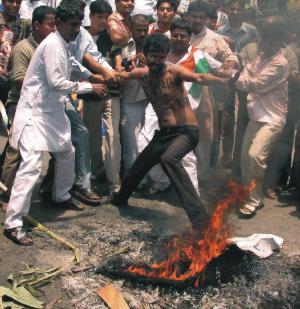
The shock decision of Sonia Gandhi to turn down the post of prime minister caps one of the most remarkable days in recent Indian politics. But why did she make the decision? "I never wanted to be prime minister," is what she told her party MPs late on Tuesday. It was, she said, her "inner voice" talking. The Italian-born Mrs Gandhi's decision should end, for the most part anyway, the controversy over whether a foreign-born person should run the world's largest democracy. Hardline members of the outgoing Hindu-nationalist Bharatiya Janata Party had said they would launch street protests if Mrs Gandhi was sworn into the post. Most of its MPs were set to boycott her inauguration. It has also been reported that her son and daughter, Rahul and Priyanka, were also against their mother taking up the position. Neither of the children have indicated that they had tried to persuade their mother to change her mind. "As an MP, I say she should be the prime minister," Rahul Gandhi told Indian television. "As a son I respect her decision." "Soniaji is my mother," Priyanka said. "She has taken a decision based on her inner voice. There is nothing for me to say... her party members have made a very emotional appeal [to change her mind]. I am sure she'll think about it." Did then Sonia Gandhi spend all that time campaigning believing that she'd overcome the criticisms of her foreign roots and the fears of assassination, only for them to reemerge as India's highest political prize beckoned? "Ultimately it's a personal decision and one cannot oppose it," veteran Communist leader Jyoti Basu said on Tuesday. Only last Saturday, Congress party MPs had elected Sonia Gandhi as their leader in parliament. That seemed, at the time, to set the seal on her taking over as prime minister. But over the next few days, it became apparent that Mrs Gandhi was seriously reconsidering the decision. On Monday evening, she kept her party MPs waiting for hours amid mounting suspense that she was planning to announce her decision to step down from the post. But then senior leader Manmohan Singh appeared to settle doubts about her intentions when he told waiting MPs that Mrs Gandhi would meet the president the following day for discussions on forming the next government. Then the doubts resurfaced on Tuesday after Mrs Gandhi emerged from that meeting with President Abdul Kalam. In a brief interaction with journalists she said she needed more time to form a government. As the day wore on, it became apparent that the script had changed dramatically. Television channels began flashing news that Mrs Gandhi had made up her mind to refuse the premiership. As the news broke, Congress Party MPs and supporters gathered outside 10 Janpath - her Delhi home ever since she left the prime minister's residence in 1989, after Rajiv Gandhi lost the election. Emotional supporters chanted: "Long Live Sonia Gandhi" and "No Sonia No Government". Others took more alarming steps to express their feelings. Other Congress politicians were distraught. "We don't know what to do," said Salman Khursheed, who won his first election under Rajiv Gandhi. "To be told suddenly that she cannot become prime minister is something we cannot accept." As a reluctant entrant to politics, when she was persuaded to take over an ailing Congress party in 1998, Sonia Gandhi lacked the experience and charisma of Indira and Rajiv Gandhi. But she made up for her lack of political skill with an energetic campaign, addressing several rallies a day and covering almost 60,000 kilometres across India. With a low-key campaign, focused on the bread-and-butter issues of jobs, food and shelter, Mrs Gandhi took the wind out of the sails of the high-powered BJP campaign which highlighted India's burgeoning economy. Attacked during the campaign for her foreign origins by several BJP leaders, Mrs Gandhi's victory is described by Congress as a decisive rejection of the argument. "It is nothing but a racist campaign," says Congress MP Mani Shankar Aiyar. "Sonia Gandhi has been elected by the people of India and she has led Congress to victory." By removing herself from the post of prime minister, Sonia Gandhi may have acted because she believed she would be a liability for her party, always open to attacks by right-wing groups. But her decision is rare in a country known for power-hungry politicians. Despite her move, she is likely to remain a key player in the country's politics. With one of her children already in politics and the other possibly following soon, the future of the Nehru-Gandhi dynasty appears very secure.
|