Cinema
German 'Heimat-films' of the 1950s
Capturing an era
A Correspondent
The German cinema lost its high position in world cinema after the Nazis came to power. The slide downward continued till the 1950s following the defeat of Germany in the Second World War. The emergence of Expressionist films in the 10 years (1918-1927) following the First World War was not only the first organised film movement in the history of cinema, but was also one of the best. In fact, the whole German cinema became a propaganda machine of the Fascists during the Nazi regime. By the time the Nazis came to power, many talented filmmakers of Germany had left the country. As result, there was a vacuum of talented filmmakers who could make films which could bring back the past glory.The German word 'Heimat' means country, part of a country or place where one is born or has grown up or feels at home as a result of continually residing there. 'Homeland' can be a translation of the German term. In the 1950s, a lot of German films were made which are termed as the 'Heimat-filme' or 'Heimat-films'. The Heimat-film was not really a phenomenon of the 1950s, but its origin goes back to the late 1920s and the early 1930s. The 'Berg-films' or 'Mountain-films' by Arnold Fanck and (later on) by Luis Trenker are generally regarded as the earliest examples of the Heimat-films. Nature plays an important role in the Heimat-films. As German cities were being reconstructed from the ruins and the Federal Republic of Germany' was being formed, a shift of settings of the films from the cities to the rural areas was essential for the filmmakers for a positive image of the country within and outside Germany. The small enclosed world of the village with its firmly fixed values, handed down from the past, was a contrast to the everyday life in the Federal Republic, a negative portrait of the period. The landscape with its beautiful scenery, would in the terminology of today, be called a fantasy, something removed from the reality but pleasant to see. There was also a patriotic fervour in these films. These films were actually made for the older generation of the 1950s and people who were growing up between 1920-1940. To them these films were a kind of nostalgic throwback to the idyllic past, rather than a reminder of their defeat and eventual destruction in the Second World War. Nobody can deny the fact that Hitler was not an 'un-popular' leader, he was, in fact, supported by the vast majority of the German people. These films were trying to present the traditional values. The younger generation was not really fond of these 'Heimat-films'. The story-lines of such films involves sentimental or melodramatic themes and relationships. These films depict beautiful landscapes in the mountains, the traditional festivals, colourful costumes and dances, folk music, and romantic sentimental affair between a Cinderella figure and a Prince Charming. One can, in this respect, draw a parallel between these films and the popular films of south Asia -- the Indian Hindi films, Indian Bengali films and of course, Bengali films from Bangladesh. The themes and treatment are so similar. The Goethe-Institut Dhaka and Zahir Raihan Film Society are screening eight Heimat-films at the Institute auditorium at Road No. 9, Dhanmondi. This special session started on May 23rd- May 27.
|
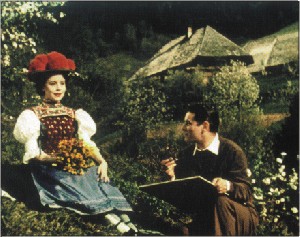
Black Forest Girl |

