Govt proposes, DoE opposes Hatirjheel plan
Sultana Rahman
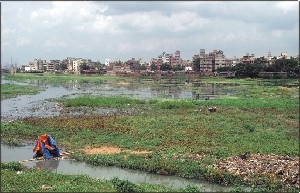
The government is firmly set to fill up the city's only remaining water body at Rampura-Hatirjheel-Begunbari to launch a controversial development project despite opposition of the Department of Environment (DoE). The first part of the project is to construct a road with a sewer through the wetland at a cost of about Tk 547 crore, while the second is to develop the roadside area. Officials said the government is giving priority to the road construction, as the city lacks an east-west road network. The DoE opposes the project and refused to give clearance for its implementation, as it has not been planned considering the hazards it may bring to the environment. The DoE asked city planners for a scientific survey -- 'detailed impact assessment' -- before implementing the project to obtain clearance for greater interest of the city and its dwellers. Sources said the project is a gross violation of the Dhaka master plan (Dhaka Metropolitan Development Plan or DMDP), which has clearly earmarked the area as a flood retention point. It is also in violation of the wetland conservation act 2000. Being one of the implementing agencies, Dhaka Transport Coordination Board (DTCB) allegedly did not carry out the environmental survey. The other agencis include Dhaka City Corporation (DCC), Rajdhani Unnayan Kartipakhya (Rajuk) and Dhaka Wasa. A DTCB official claimed that Rajuk that formulated the wetland protection act 2000 in April can determine how the act should be implemented. "As Rajuk holds authority, we do not need clearance from DoE. Rajuk is one of the planning and implementing agencies of the project," the DTCB official said. DoE sources said if the Hatirjheel area was filled up, the city would face an unprecedented water-logging and all roads and localities around Hatirjheel would be inundated with slight rainfalls. Many environmentalists expressed concern over the project and said the area is naturally designed to retain storm water of an area covering 40 square kilometres. Meanwhile, the project concept paper of the road is waiting for approval of the Executive Committee of National Economic Council (Ecnec). A pre-Ecnec meeting last month asked for the scientific survey before construction over the wetland. To implement the project, the government has to acquire around 200 acres and the initial project cost was Tk 1,022 crore. DTCB sources said the pre-Ecnec meeting did not give the approval, as it is lacked soil test and scientific-data on water-flow. Soon after the meeting, the DTCB employed the Institute of Water Modelling (IWM) that recommended digging out at least 22 feet to reach solid land. The IWM also suggested water treatment of the wetland on a regular basis as a third of waste of Dhaka drains away through the wetland. The Ministry of Local Government and Rural Development (LGRD) initiated the project, which will extend from Tongi Diversion Road to Pragati Sarani, covering 237.64 acres of low-lying land. The state owns 37.64 acres along the stretch. DoE senior officials said they are not against the development project if the city needs a east-west road network, but it should be built considering the environmental aspect. "Development does not mean overlooking ecological balance and the present situation requires environment friendly solutions," said Md Reazuddin, deputy director of the DoE. Meanwhile, some developers and realestate companies as well as some 'political-powerful' groups are gradually filling up the wetland. Some organisations have already hanged signboards claiming their land that includes a renowned private university. Some developers realestate companies are also filling the waterbody at night to escape the law enforcing agencies. DoE has filed at least four legal notices against three realestate organisations and a private university charging on filling up the wetland illegally. "To protect the wetland, government should take action against the grabbers and other necessary initiatives," another DoE official said adding that government can make it as a sight for leisure trip where city dwellers can visit. "Following the environmental assessment report, they can also build a road network," the official said. Dr Anisuzzaman of International Union for the Conservation of Nature (IUCN) said a densely populated city like Dhaka requires 25 percent wetland for smooth breathing and healthy sustainable habitat of various species of flora and fauna. But Dhaka has less than 10 percent wetland that not only threatens its own liveliness but also destroys the livelihood of many people, especially the poor who depend on it, Anisuzzaman said. "We have to understand that a wetland is not a wasteland. A wetland gives us much more than money can buy," he said.
|