Living in death traps
Century-old dilapidated buildings, unplanned structures put thousands in Old Dhaka in danger
Pinaki Roy
While all eyes are focussed on Shankhari Bazar following last Wednesday's tragic casualties in a building collapse, thousands of others continue a precarious living in century-old decrepit buildings, including some archaeological sites, in other parts of Old Dhaka. It was found yesterday, a madrasa has housed its juvenile students in the South Plaza of Bara Katra, part of an archaeological structure built in the Mughal era. The structure is in ruins and so vulnerable that it may collapse any time. "Out of our 450 students, at least 150 are living in the Bara Katra building," said Abrarul Haq, 12, a student of Jamiya Hossaina Ashraful Ulum Madrasa. Some grabbers on the other hand are using Chhoto Katra, another archaeological building of the same age as Bara Katra, for commercial purposes. Both the Katras were built between 1644 and 1663. But, instead of the archaeological department taking them under its protection, the historical buildings are still being used for residential and business purposes. Some other archaeological sites, including Ruplal House, Nawabbari Gate, Ahsan Manjil and Nilkuthi, have also fallen into so bad a condition that they are also feared to be broken down anytime. But the department of archaeology fails to maintain them for lack of funds, officials concerned said. Neither Rajdhani Unnayan Kartripaksha (Rajuk) nor Dhaka City Corporation (DCC) has been paying adequate attention to the urban areas of Old Dhaka, the establishment of which dates back to the 16th century. These two agencies even do not have any proper list of the ruined and high-risk buildings in the city. Now they are only trying to shift the blame for the Wednesday's catastrophe on each other. "As far as I know, Rajuk doesn't have any specific plan about the old buildings of the city," said a top Rajuk official, who did not want to be named, as he said, "It has become a very sensitive issue." Rajuk has a list of only 120 unplanned buildings across the city, but no list of risky buildings. On the other hand, according to the Planning and Design section of the DCC, the number of risky buildings is 81 in its Zone-2 covering the old parts of the city. But officials of both Rajuk and DCC admitted to The Daily Star that the number of risky buildings would be no less than 1,000. Recently a private firm working for the DCC has carried out a survey of the aged buildings in the old city. The survey marked more than 500 buildings as vulnerable.
|
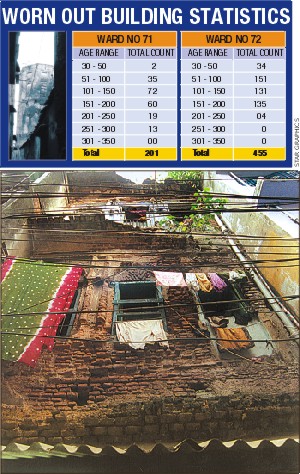
CLEAR AND PRESENT DANGER: One of the run-down buildings stands threateningly in Shankhari Bazar in Old Dhaka. PHOTO: STAR |

