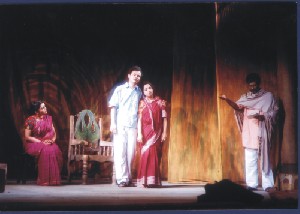
Dhaka Drama Festival 2004
Dhaka Drama Festival kicks off
Enjoy drama on stage, Come to a new stage'--with this slogan Dhaka Drama Festival-2004 opened at the Experimental Theatre Stage on June 17. Many renowned cultural personalities of the country attended the inauguration programme of the 37-day long drama festival arranged by Bangladesh Group Theatre Federation (BGTF).Professor Sirajul Islam Chowdhury was the chief guest while Kamal Lohani was the special guest in the inauguration session. After the introducing speech of Aktaruzzaman, Programme Secretary of BGTF, theatre persons Ramendu Majumdar, Ataur Rahman, Liakat Ali Lucky, SM Mohsin and Sara Zaker spoke on the occasion. The programme ended with the speech of the chairperson of the session, Mamunur Rashid. The speakers pointed out the glorious scenario of the Bangladeshi theatre and the honour it has brought them from the foreigners. They also demanded that the government should provide more facilities to nurture the rich theatrical condition of the country.
Review Mayur Shinghashon An anti-fundamental play Aranyak Natyadal staged Mayur Shinghashon on the opening day of Dhaka Drama Festival-2004 at the Experimental Theatre Stage at Shilpakala Academy. Most of the characters in Mannan Heera's play Mayur Shinghashon are rural theatrical artistes. Through their theatrical activities the playwright has depicted the crisis of the minority people of the '60s. The tragic ending of the life of Dilip Das, the protagonist of the play, is a true story in the case of many minority people of that period. Many patriots belonging to the minority community of those days had to leave the motherland in the face of the fundamental approach of the rulers. Heera's dialogue diction is perfect to represent the artistes of a rural troupe. The character of Secretary realistically represents many people of this kind who buy off artistes and use them for their own personal interest. Behind every relief scenes in the play, there are clear indications of pathos. Through this irony Heera has successfully portrayed the hidden tragic lifestory of many rural artistes. Shah Alam Dulal as the director of the play is realistic. He has successfully created the atmosphere of a rural troupe of the '60s as well as the Shmawshan scene (where dead bodies are cremated), the most important part of the play. However, as the performing space of the Experimental Theatre Stage is smaller than that of the Mahila Shomity Stage, the blocking should have been modified according to the demand. Set designer Faiz Zahir has used cloth, a throne and a few stools as his suggestive set materials. The Yellowish colour of the curtain symbolically represents betrayal. Light Designer Thandu Raihan has composed his design by using only shadow-light effects. Not much symbolic colour effect has been used in his design. Fazlur Rahman Babu as Amalya, Aminul Haq Helal as the Secretary and Joyraj as Hari could fulfill the demand of their characters.
|