Byline
A Florence diary
M.J. Akbar
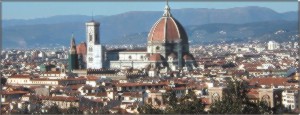
Florence: The defining difference between the Englishman and the Italian is the gesture. An Italian speaks on the telephone with both hands, neither of which may actually hold the instrument. The phone is cradled between chin and shoulder, leaving the hand free to gesticulate while the fingers create intricate patterns to reinforce meaning to someone miles away, at the other end of the phone, and therefore completely unable to see this hand-dance. The real purpose of this exercise in stress and delicacy, in other words, is to express for the sake of expression, rather than for the sake of communication. Thus does every telephone conversation become an art form, a dance of hands and fingers to the rhythm and nuance of speech.The Englishman from the rigid, Teutonic north does not know the potential creativity of hands. The Englishman not only has a stiff upper lip but also a stiff lower hand. John Cleese in Fawly Towers may exaggerate, but his excess is firmly rooted in fact: the Englishman prefers to walk or talk with his fingers pointed firmly south. The Italian of the liquid, Latino south is more like an Indian. A 'where', a 'must', a 'there', a 'what', or any of the wide range of exclamations is incomplete without the finger dance. The only time Italians throw their arms down is when they are flabbergasted. The only time an Englishman throws his arms up is when he is flabbergasted. Is this subconscious? One must address this question in these Freudian (or perhaps just slight post-Freudian) times. Does the Englishman associate raising his hands with surrender, and therefore considers it beneath his dignity? Could be. These tough colonial types hate surrender and will do anything to prolong the agony of conflict rather than obey the dictates of common sense. Italians, on the other hand, so to speak, have surrendered to the pleasures of good life for countless generations. Duty doesn't call around here anymore. They did their best fighting about two thousand years ago, and now sell that memory to tourists while they concentrate on the joys of living off an extraordinarily beautiful land. Perhaps that is why Winston Churchill growled, when informed that Italy had joined Germany and the Axis Powers in the Second World War, that it was only fair: after all, Italy had been on Britain's side in the First World War. They should become someone else's handicap this time around. When was Florence born? The facts are arid. It was an Etruscan village like thousands of others whose names we do not remember. Julius Caesar created Florentia (meaning flowering) in 59BC for the best of reasons, because it was the most convenient crossing point on the river Arno for his armies. Before Caesar, the village was a mere truth; he reshaped it into reality. The difference is magnificent. The power of Italian genius lies in its ability to lift truth to a higher dimension by a powerful vision. And so, when Florentians sneered that Michelangelo's statue of the dissolute Giuliano was too heroic to be a likeness of the wastrel son of Lorenzo the Magnificent, Michelangelo answered: "In a thousand years no one will know how they looked!" Or, they will look as I have made them look, because my art will last a thousand years, while their bodies and their reputations will be consumed by time. Time surrenders only to art and fable. Such was the myth of the Roman empire that it continued to be called Roman long after Rome had nothing to do with it. The term "Roman" added legitimacy to emperors of the east and west of Europe who were Turko-Greeks, French or Germans. Florence flourished under the pagan Romans, and when the eastern Roman empire under Constantine made Christianity legal, constructed a church on the spot where the glorious cathedral now stands, overpowering an opulent city with its scale and splendour. When power shifted west, Florence was ruled for three centuries by Charlemagne's Franks. In 1100 it won independence from the Germans who had taken possession, and with this began its age of glory as a city state, before bowing to Napoleon and then the Hapsburgs. In 1848 Italy began to cohere as a nation under Victor Emmanuel. Florence joined the new kingdom in 1860. Rome became the capital of modern Italy in 1870; Florence remains the capital of European art. Any city that can claim Giotto the architect, Donatello the sculptor, Benvenuto Cellini the jeweller, Dante ("I am the father of the Italian language") and Petrarch the poets, Boccaccio the storyteller, Amerigo Vespucci (now you know where America comes from) the discoverer, Galileo the scientist, and Raphael, Leonardo da Vinci and Michelangelo the artists as its children must have superlative genes. The statues of the city's best and brightest adorn the courtyard of the Uffizi gallery, home to Europe's greatest artistic treasures. The most remarkable of the statues are those of Dante Allighieri and Nicolo Machiavelli. Dante seems a contradiction. Could anyone so austere and purse-lipped really be in love with anyone but himself? And so Beatrice, his love and guide, must surely be an artistic conceit necessary for his journey through faith and prejudice across Paradise, Purgatory and Inferno. Did Machiavelli really look that Machiavellian? The Florentines certainly think so. His eyes glitter in stone. they slant to the right as if a direct gaze would be too honest. A smile of high intelligence and low craft plays upon his lips. His head is bent forward, his shoulders seem to participate in a ploy, tilting to hide a stratagem. Those familiar with The Prince know that it is more realpolitik than ruthless, but the statue is a fine image of cunning. I did not find the cunning despicable. It was craft in service of power, not the craft of a moneylender who steals from the poor. And yet it made me shudder. For this was an image of power unhinged, of power without morality, or power unredeemed by any idea of service. The dharma of such power was only more power. I have not seen a statue of Chanakya. My image of him comes from a reading of Arthshashtra, a cool treatise rather than a cold one; untrammelled by sentiment but as heavily anchored to the good of the state as to the good of the monarch. I can see why Jawaharlal Nehru once flirted with the idea of becoming a Chanakya, even as he laughed at himself for such fantasising. He had no time for Machiavelli. A story illustrates the difference. Chanakya, after winning a kingdom for his prince, Chandragupta Maurya, sought permission to retire and return to Takshila. Chandragupta was aghast, for this was the time to reap the rewards of victory and rule. But for Chanakya, this was enough. He had a last word of advice to the new monarch. He should make the defeated general a commander of his armies. This, said Chanakya, is the best guarantee of future peace. The lesson applies in today's politics as well. The first thing to do in victory is woo the next enemy, not make an enemy of a potential ally. Machiavelli went to prison and died powerless because he was too much in love with power. Chankya died in peace because he knew the limits and limitations of power. Are art and culture synonymous? Are you automatically cultured because you can create great art? I am not sure. Dante wrote super poetry, but was he cultured? It is fortunate that no one reads the whole of Dante in India. I got a brief look at him at university and returned to his work at greater length only during my researches on the conflicts between Muslims and Christians. Anyone who has read Dante on the Prophet of Islam and on Islamic icons like Hazrat Ali will know that Salman Rushdie has been banned for much less. Dante is vicious. Can a bigot be cultured? I think not. Florence is overwhelming even when glimpsed briefly. I have seen nothing, and yet after a visit to the New Sacristy of the Medici Chapel it seems as if I have seen everything, and must pause before I return to see more. Michelangelo's elegy to time in four statues is a pinnacle of human achievement. Lorenzo II died without a male heir at the age of 27, of tubercolosis and syphilis, symbol of the decay that killed the most colourful and eponymous dynasty of Italy, the family that made Florence both a Jerusalem of art and a Babylon of sin. The artist was commenting on age that had disappeared, on a family that he loved, and on his own age, for he was in his 50s now, and tired ("If I work one day, I need four to rest" said the man who when inspired used to work with minimum sleep and less food). During the fourteen years he spent on the chapel, he lost his father, his favourite brother, his bastard-stepbrother Pope Leo X, the Medici dynasty, and, to raise the ante, witnessed the plagues of 1522 and 1527. Time is defined by four images: Dawn is a woman, with restless eyes, her body half asleep from the night and half-thrusting for the promise of the day. Beside her is Dusk, a man with a fading face, whose tired body heaves as it seeks rest from the labours of the day: you can see the marble body heave gently, and the illusion becomes the reality. Across the sacristy are Day and Night. Day is a powerful man whose face has been left deliberately incomplete, an impressionist series of chiselled notches, and whose limbs twist in myriad directions as he rests against one powerful arm draped behind his back. Night is beautiful, a gentle woman who sleeps in supple strength, a shimmer with a crescent moon on her forehead, an owl under her knee, and poppies under her feet. Michelangelo wrote verse on sleep: As long as shame and sorrow exist
I'd rather not see or hear
So speak softly and let me sleep. Beside Sleep lies a mask, at first sight demonic. But look intently at that mask, and it forms a face. Is that the signature of Michelangelo lying beside sleep? MJ Akbar is Chief Editor of the Asian Age.
|
|

