Powerful portraits of women and children
Sheikh Afzal's solo at Saju Art Gallery
Fayza Haq
Sheikh Afzal, in his recent exhibition at Saju Art Gallery, has used oil, acrylic and water colour. In the large works he has first applied an acrylic texture and then oil, while the water colours followed the traditional technique of the Japanese school, where he had studied. In the latter, Sheikh Afzal had taken themes from around him, as in the Sunderbans and Bandarbans, but the style of presentation was Japanese. Here importance had been given to the focal point, which had been surrounded by empty space or simple masses of colours, standing for mountains or clouds in the distance. Even the lettering was done in the traditional Japanese way. As for figures, for Sheikh Afzal, children stand for innocence and hope, while women stand for beauty and joy. There are few Bangladeshi artists who have presented human figures with so much of care, sympathy and understanding. Sheikh Afzal, in his recent works, has adhered to realism. Earlier he used to do abstraction and semi-abstraction, but returning from Japan in 1993, he combined abstraction with realism, bringing in a contemporary style to the delineation of figures and faces. There are currently only a few artists who adhere to realism, such as Rafiqun Nabi, Jamal Ahmed and Ranjit Das. His patrons remain foreigners and intellectual local art enthusiasts. Sheikh Afzal has used a lot of brown and beige as well as blue in particular. 'The blue came into my work on its own. I didn't purposely put it there with some particular thought behind it.' In one of the large paintings is a woman surrounded by girls and children. Nature is also intertwined in a subtle way with the human figures. When he prepares the base, he gets forms, which he later develops. 'You can find abstractions in the realism just as you come across abstract shapes in a painting such as Kibria's Kaktarua If you enlarge an object you're bound to find some abstraction in it, such as a fragment of a wall or trunks of trees. Thus in another painting are many studies of limbs of children, seen in movement. This lends an element of modernity.' He first draws his figures with charcoal or pencil on a piece of paper from memory, keeping in mind that he will transfer it on to the canvas. When doing the actual work, he takes the help of live models, who are more often than not women from the slum areas. When studying at the Art Institute in the 1970s, he had been guided by Rafiqun Nabi, Mahbubul Amin, Shahid Kabir and Abdul Basset. His teacher in Japan had been Professor Fumihiko Yamamoto. His contemporaries included Nisar Hussain, Wakilur Rahman (who now resides in Germany), and Saidul Haque Juisse, who still form a group of their own, and often sit together exchanging ideas. Along with painting Sheikh Afzal does a lot of illustration for supplements of various Bangla newspapers. He has taken part in over 15 solo exhibits in Japan, Italy, Bahrain and Dhaka. He has won various awards, including the UNI Group Award, 14th National Art Exhibition, Shilpakala Academy, 2000.
|
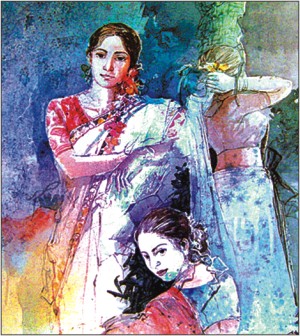
Intimacy, Mixed media |

