Lost in the labyrinth of law
Polythene makes a comeback because of confusing cop role, weak monitoring and poor infrastructure
Mizanur Khan
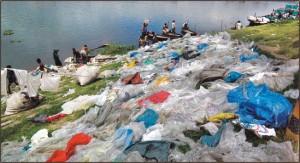
Illegal polythene traders remain out of the police dragnet, as law enforcers are reluctant to catch them on apparently flimsy grounds that they were not directly empowered by law.But the Department of Environment (DoE) says a circular on May 4, 2002 outlines that a police officer can act as an inspector to arrest offenders and file cases for environmental offences related to polythene although the conservation law does not stipulate any role of the police. According to Section 17 of the Environment Conservation Act 1995 and Section 2 of the Environment Court Act 2000, a DoE inspector or any other person authorised by the director general of the department can act as an inspector to file cases against violators of the law. But police officials told Star City that they were not given enough power and authority to net the polythene sellers and producers. "When we launch a drive against the illegal polythene traders, we face a lot of problems as the police have not been directly authorised in the texts of the Acts," a police officer said, requesting anonymity. Police officials said they should be directly empowered and the word 'police' has to be clearly written in the texts of the Acts. "All environmental offences under the Environment Conservation Act 1995 should be declared cognisable offences," a senior police official said. But environment ministry and DoE officials said cognisable offence is a sensitive issue and the police using this power can arrest anybody without warrant issued by the court. "That will be very destructive to the business community and the interest of the country. With this power, dishonest policemen can misuse the law and harass people," said a high official of the law ministry. Sources said the home ministry and the environment department exchanged several letters over the dispute but the problem has not yet been solved. Experts said nowhere in the world have the police been directly authorised to take action for environmental offences. They also said the DoE officials would not be able to misuse the power directly what the police might do. "Check and balance is ensured in the process as the police have not been directly authorised in these two Acts," an environment ministry official said, adding: "The circular clearly says about the role of the police." A case against the state, filed by a polythene producer with the High Court, was reported in December 2003 issue of the monthly law journal, Bangladesh Legal Decision (BLD). In the case-- Sirajul Islam Vs the State -- the authority of police to investigate polythene offences was challenged. The court in its verdict said the delegation of power to the police officers by the DG of the environment department is lawful. Polythene banned on January 1, 2002 made a full comeback into the city, the experts say, because of poor infrastructure and a weak monitoring system. "We do not have any monitoring cell but a taskforce led by the director general for the implementation of the law," DoE Director Riazuddin Ahmed said. A visit to Karwan Bazar, New Market, Baitul Mukarram, Islampur, Gulistan and Farmgate made it evident that the use of polythene has continued over the last two years violating the law. As a camouflage measure, only the shape and colour of bags have changed since the ban was slapped. "To avoid legal action most factories are producing polythene bags without the cut-out space for the grip which is but eyewash," said Amit Ranjan Dey, an activist and member secretary of the Polythene Bag Protirodh Samannay Committee, a non-governmental organisation to resist polybags. Most people now use nylon and net bags and these bags, when burnt, emit hazardous fumes as polythene, experts said. "In the absence of an alternative, it has not been possible to stop the use of polybags altogether. But it is for sure that the use of polythene has been reduced dramatically over the last two years," the DoE director said. "People are now aware of the use of polythene and you will not see polybags left in the streets and dustbins," he added. "We sincerely want to stop it but cannot clamp down on the manufacturers, as we are understaffed," said Abdus Sobhan, another DoE director adding: "This is not the duty of the DoE officials to go to the streets and markets to arrest the polybag sellers. For this we need law enforcers and magistrates but we hardly get them on demand." A large number of clandestine factories are manufacturing the polybags in Mohammadpur, Lalbagh and Islam Bagh areas. Sources said small factories are paying the police to operate and market the products. Years of indiscriminate use of cheap polythene bags ultimately became a serious environmental threat to the environment. Discarded bags clogged sewerage lines, surface drains and damaged fertility of the soil and polluted canals and rivers. Violators of the law will be sentenced to six months in prison or be fined Tk 10,000 for selling, display, storage, distribution, commercial carrying and use and will be sentenced to 10 months in prison for production, importation and marketing. "More campaign, enforcement and an alternative to polythene are urgent to make the country free from the banned item," an environment activist said.
|