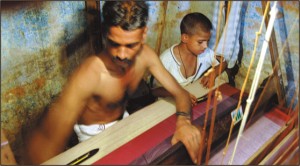
Chirpy childhood in shackle of poverty
News Network Feature
Raju and Ramiz, aged around 12 want to go to school. They want to study. But poverty compels them to work to help to put food on the table to keep the home fires burning.Raju works at a weaving factory for eight hours on average a day. He helps the weavers of Mirpur Benarasi Palli with thread and sometimes does the borders himself, in a poorly lit room and carries home a fat wage of Tk. 10 at the end of the week. Ramiz works at another factory, helping his father who desperately is looking at stepping on the accelerator of his work. "I have six children and it is quite difficult to take care of them. If my son works, the family benefits," said Sabdar Mia, Ramiz's father. "I cannot afford to send him to school," he added. There are other boys like Raju and Ramiz working in the weaving town of Mirpur, best known for making quality saris, especially Katan and Benarasi, the bridal dress. These boys are ill paid and work under excruciating circumstances. Condoning the work these boys do, their families said that school was out of the question. Some boys are assistants to their weaver fathers. These factories have three types of workers: the weavers and senior and junior helpers. Each weaver is paid on the basis and the type of sari he makes, ranging from Tk 300 Tk 1,200. The faster a sari is made the bigger the income. The main artisans feel that it is impossible to work without help such as handing thread and running other errands for them. Artisans do not consider work by children as abuse as the work these children do is lighter and better than they do in tanneries or bidi factories. Abdul Jabbar Chowdhury, a weaver's association leader in Mirpur said that poverty drives the families to send the children to work even though the wages are low. Families do not mind such poor wages because they feel that it is better for the child to be employed rather than idle at home. "On the other hand," he also said, "An artisan needs around 12 days to make a good sari, but with help from these boys, he could do it in a week." "In countries like Bangladesh, child labour cannot be eliminated. Children have to work to help their families and this is a cottage industry where all members of a family work together," said Dr. MA Azim Jahangir, head of planning and implementation division, Bangladesh Handloom Board. "Weaving a sari needs at least two hands the artisan and someone to help him, which helps cut costs and improve the artisan's skill," added Azim. This cottage industry employs children of various ages and according to a study there are at least 590 children, many of them as young as eight and at least 62 percent work 13 hours a day. This some people grumble deprives children of education and affect their health. Problems relating to child labour are complex and these problems cannot be fixed overnight. There are schools and organisations funded by ILO where education is free, but this does not attract poor children. Whether or not children are made to work by poor parents who cannot afford to educate these children, the work means a violation of children's rights. The weavers association, however, favours a middle path. Give children less working hours and allow them time to go to school.
|