Living by selling out everything
Kamrangirchar dwellers part with their cattle, poultry to get by
Julfikar Ali Manik, back from Kamrangirchar
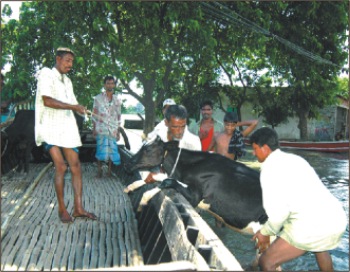
In Kamrangirchar, close to the capital, the flood has not only made poor old women like Asiya Begum homeless, but it is forcing them to sell their last resources such as cattle and poultry for survival. For traders like Abdul Rafiq, the flood has brought windfall profit as they are buying cattle cheap and selling them at a high price. The flood-affected people in Kamrangirchar are spending their days amid uncertainty and without any relief. Villagers like Asiya Begum were rendered homeless by a dramatic rise in flood water on Saturday. Asiya, 65, took shelter at the Al-Hera Community Centre in Kamrangirchar's Sirajnagar area along with her six goats and two chickens. The goats have posed another problem for her as she cannot find fodder for them. She had to sell one goat at a throwaway price for her own survival. Yesterday she was trying to sell the remaining five goats. "I don't have food or shelter for myself. Where shall I keep these goats?" says Asiya. When she moved to the community centre on Saturday night by a rickshaw-van, she did not have the money to pay for the trip. She sold two of her chickens for Tk 120 to pay him. "In normal times, I would have sold just one chicken for Tk 120. I sold the goat for Tk 1,000, which actually would have fetched me Tk 3,000 in normal times," Asiya lamented. As the poor flood-hit people in Kamrangirchar are selling off their domesticated animals at throwaway prices, cattle traders move around villages of Sultanganj union to take the advantage. Rafiq bought two cows yesterday when this correspondent talked to him. "I will sell them at high prices," Rafiq said. "I am here because I came to know that people are selling cattle. I can get each of them cheaper by anything from Tk 2,000 to Tk 3,000." The flood crept into the villages of Hujurpara, Sirajnagar, Mansurbag, Mominbag, Pashchim Nabinagar and adjacent areas under the Sultanganj union on Saturday night. The sleeping villagers woke up to find their beds soaked by the floodwaters that rose suddenly overnight. "We could not even save our valuables because we did not anticipate such a sudden flooding," Lajjatunnesa of Hujurpara village said. "We shifted whatever we could. But we had to leave most of our belongings back home." Another flood victim Shefali said, "I woke up to see my 18-month-old son crying as he fell from the bed into floodwaters already on the floor." Sakhina Khatun of Hujurpara village lost one of her eight cows in the flood Saturday night. She is trying to save the remaining seven. "But if I cannot arrange fodder, I may have to sell them," she said. Many of the villagers have flocked to the capital for shelter. Others gathered on the inundated Sirajnagar road and trying to find a dry place. A member of Gram Sarkar, Sirajul Islam, arranged their shelter at Al-Hera Community Centre. The centre is now sheltering over 1,500 flood victims. "I met with the Gram Sarkar chief Nazimuddin Nazu Sunday. He said ministers and parliamentarians will visit our place today (Monday) and then we will come to know what kind of relief we will get." As the situation looks grim, the flood victims are taking doles in the form of rice, pulses and other essentials from the better-off locals and preparing Khichuri. "For the last three days, I am living on puffed rice and biscuit. But we are facing an acute drinking water crisis and sanitation problem," said Shahinoor, another victim at the community centre. Diarrhoea, fever, cough and other water-borne diseases have started spreading in the area. The poor working women of Sirajnagar are unable to go to their work. This has already affected the local garment factories. Shamim, production manager of Teen Sweater Limited, said, "Of our 750 workers, only 350 turned up yesterday. So, our production has nosedived to 1,000 pieces of sweaters a day from 2,500."
|