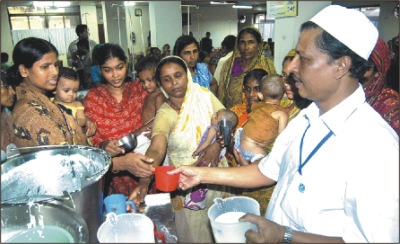
Diarrhoea epidemic breaks out
Staff Correspondent
Diarrhoea outbreak in the flood-affected areas has reached an epidemic proportion although the health ministry is yet to admit it. The waterborne disease has struck 14, 17,669 people since the beginning of the month, including 3,658 people yesterday, and claimed 14 lives, according to a government estimate. But unofficial estimates put the figure at five to six times higher and the death toll no less than three times the given number. Private medical practitioners in many districts said they are unable to cope with the increasing rush of patients. Private clinics in many districts and upazilas are submerged while an increasing number of patients had diarrhoea. "There is no reason to declare a diarrhoea epidemic," Professor Mizanur Rahman, director general (DG) of health services told The Daily Star yesterday. "We have sufficient quantities of oral and intravenous saline and today I have ordered for doubling the production." The DG, however, said the worst form of the diarrhoeal attack is yet to come. "Soon as the floodwater recedes the chances of large-scale diarrhoeal attack will increase. This is common as the bacteria concentration rises with the fall in water level," he said. According to sources, thousands of people, mostly children who are susceptible to the waterborne disease caused by ecoli bacteria, are falling sick every day in absence of safe drinking water. "People are forced to drink contaminated water for survival. Many people who live in the remote areas neither have fuel to boil water nor have they any access to water purification tablets," said a civil surgeon in Rajshahi. "The reality is that people have to come to the temporary medical camps for treatment but many diarrhoea-affected patients are unable to come because there is hardly any transport in the flood-affected areas." In Sylhet district, many affected people in the remote Haor areas have no access to medical treatment. Diarrhoea patients are thronging hospitals and upazila health complexes. The health directorate claims to have sufficient quantities of oral and intravenous saline, but many places have been plagued by a crisis of saline. The health directorate yesterday deputed officials to 36 flood-affected districts to especially monitor public health situation in the affected areas and advise the directorate on handling the situation in case of a crisis. The Unicef and the World Health Organisation (WHO) offices in Dhaka meanwhile have donated 20 lakh water purification tablets for distribution among the flood victims. The health directorate has requested an additional 10 crore tablets from the UN agencies for immediate supply. The Institute of Public Health (IPH) in Mohakhali has been ordered to double its intravenous saline production from 14,000 a day to 32,000. Similarly, oral saline production has also been doubled from 200,000 packets a day.
|