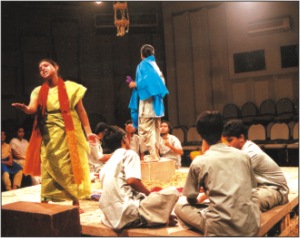
Behular Bhashan
The play presents the indigenous performing art form
Ershad Kamol
MA students of the Department of Theatre and Music of Dhaka University, staged Behular Bhashan based on the six commandments of Padmapuran or Manoshamangal. The play was held at Natmandal Auditorium at Dhaka University on July 29. The show was a fumdraiser for the flood victims.Biplab Bala has adapted the traditional 600-year old rural myth of Manoshamangal with a modern connotation. Biplab's Akkhanbhashya (excerpt from the story of the myth) depicts more than a mere ritual of goddess Manosha, which the rural bards present in their pala-gaan to show the conflict between religion and power. Although like pala-gaan, Biplab's narrative script is written in verses, he rather portrays the bitter experiences of a loyal wife, Behula, at the hands of society. Behula's journey with the dead body of her husband Lakhindar on a vessel in Behular Bhashan has an inner meaning. During the journey, Behula faces seven evil men-characters who symbolically represent the wicked instincts of masculinity including lust, cruelty, hypocrisy, extravagance and pretension. And Lakhindar's resurrection represents his giving up of these evil instincts. Biplab's aim in the play is to show the union of two innocent human beings. As the director of the play, Jamil Ahmed's approach is totally different from the traditional directors who basically follow either European Drama Form or Mixed Art Form. In Jamil's experienced hand, the decaying rural art form--Monosha Pala--has achieved more polished and aesthetic shape. He has unfolded the play through a narrator who is also one of the three characters in Behular Bhashan. The narrator introduces every new experience that Behula undergoes in her journey. The most interesting part of Jamil's indigenous art trend in choreography is the presentation of the combat between Behula and some vultures which want to eat Lakhindar's flesh. Jamil has used Dohars (chorus) and Bayens (orchestra) to support his three-character play. Set designer Kamaluddin Kabir has made a Chaukona Khola stage (a square shaped empty space) in the middle of the theatre hall and the audience sat at the four corners of the stage. Using four stools and straw he has created a different atmosphere for the different sequences of the play. He has used general light throughout the play. However, a symbolic light effect could have enriched the quality of choreography. Collected songs from Padmpuran Gaan and Padmar Nachan trend have been used in the play. As the story teller in the play, Lima's voice modulation was excellent. However, her physical movements during the songs need to be improved. Tania as Behula fulfilled the demands of her character. However, in the second part of her journey when she faces a lecherous old man she smiled during her performance. She was responding in this manner at the sight of Swati as the old fellow--which decreased her bold appearance as Behula. Swati's representation of seven evil men--who symbolically represent the dark side of the masculinity--was enjoyable.
|