The pristine setting of Shantiniketan
Fayza Haq
Shantiniketan is Tagore's amar kirti, something which is unparalleled. I myself feel that I'm alive through Tagore's poetry and painting. The lyrics of his songs are there to support you no matter in what mood you are. The university that he has created is asram kendrik and aimed at meditation. Here you can meditate at will,' says artist Rokeya Sultana. 'During Tagore's time, people in Shantiniketan lived in thatched houses and people went about barefooted. No religion was allowed to have a foothold here. In this residential university the students planted their own trees from which they harvested the fruit. There is the pathak bhaban (school) where classes are held under the sky.'Rokeya says that the university is based in the tribal area of the Santals and the students learn everything from economics to literature, music, dancing, painting, and dramatics. Keeping the university in mind, a township has come up with a single road winding through. The artificiality of urban life is, thankfully missing. Famous personalities such as Indira Gandhi and Satyajit Ray have been through the portals of Shantiniketan. Every Tuesday there are prayers in the early morning with Tagore's puja songs. Students are surrounded by the sky, a close by river, fresh breeze and plants. Students like Rokeya are so influenced by Tagore's teaching of nature that even today nature prevails all over her paintings. Going from a metropolis like Dhaka to the natural surroundings of Shantiniketan had a profound effect on Rokeya. 'There was krishnachura, kanchan and polash all around me and I felt the change of seasons within me, being affected by my surroundings. The kash flower surrounded the lakes and one could even go for the juice of taal in the nearby villages,' says Rokeya. During the bashanta utshab (spring festival), a line of students extending to two miles sing the song Ure griho bashi tora khol dar khol laglo je dol with garlands of polash on their neck and little sticks in their hand. Pahela Boishak is another such seasonal festival. 'This influenced my nature-based landscapes. I found a philosophy to sustain my paintings. I could concentrate at will as this is a place to meditate in. My teachers like Samnath Hor, Lalu Proshad Sho, Sanat Kar,Subramanyam and Jogen Chowdhruy were very understanding and warm. We didn't call them 'sir' but 'dada'. They took the place of artists in Tagore's time like Ramkinkor, Abanindranath Thakur, Nanda Lal and Binod Bihari Mukherji. The atmosphere of simplicity has continued from Tagore's time. He himself lived in mud houses like Shaymoli and Utarayon, one of which has been converted into the Tagore museum. In front of our Kolabhaban (Art's building) was a wonderful sculpture of a Santal family by Ramkinkor. In between we would have breaks of tea in the canteen and chat with our teachers.' Shawkutazzaman, adding his own experiences at Shantiniketan said, 'My teachers in 1988 were Jogen Chowdhury, Shuhash Rai and others like Lalu Proshad. They never kept us at an arm's distance. The understanding and rapport which I found there was something that was missing in the Art College in Dhaka. This was something I was looking for all along. I learnt mural, tempera and other forms of painting. There, at Shantiniketan, I learnt about Tagore as a real living person and not as a distant poet of the past.' Talking about the atmosphere, he said, 'The food used to be brought in pails, first rice, then fish and then vegetables. The roads were not paved. I also greatly enjoyed the presence of the Santals there as we worked from morning to dusk.' He describes his colleagues as friendly and fun to be with.
|
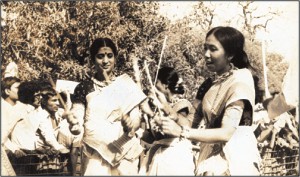
Spring festival at Shantiniketan with Rokeya Sultana and her Monipuri friend Krishna |

