9,800 more ill with diarrhoea, Unicef fears epidemic
Staff Correspondent
A diarrhoea epidemic threatens to emerge as 9,823 more people, mostly children, landed in hospitals and another two died from the waterborne disease, health officials said yesterday. The health directorate recorded 95,336 diarrhoea patients in 38 flood-ravaged districts and 56 people have died from the disease since July 12. "Our concern in the last few days is the risk of an epidemic of diarrhoea," AFP quoted Unicef spokesman Marc Vergara as telling journalists in Geneva. As many as 703 patients were admitted to the International Centre for Diarrhoeal Disease Research, Bangladesh (ICDDR,B) in less than 24 hours on Tuesday -- a figure officials described as quite high, which overtook the average number of 600 cases a day. On the sudden surge in diarrhoea, the director of the ICDDR,B clinical sciences division, Dr Abdus Salam told The Daily Star: "We cannot term the outbreak an epidemic but the incidence is definitely very unusual." Most patients at the centre are from flood-affected areas in and around the capital and have all reported falling sick from drinking contaminated water. "We don't have access to safe drinking water in and around the shelter in Goran. We are forced to drink from a distant water tap used by hundreds of other local residents," said Kashem, a rickshawpuller, now under treatment at the ICDDR,B. The centre's register of patient admission shows that 2,525 people, mostly children between 6 months and 5 years, have been admitted to the ICDDR,B since August 1 that invented decades ago a simple oral re-hydration therapy, popularly known as ORS, which saves millions of lives across the globe today. Most patients from suburbs being treated at the ICDDR,B said they have no option but to drink contaminated water, as access to safe water is now a costly matter. "A bottle of water sells as high as Tk 25 in Basabo, Mugda and Khilgaon. How many do you think can really afford such luxury?" asked a housewife from Mugda. The ICDDR,B officials said the number of beds for daily treatment may exceed 1,000 and they are ready to set up more beds if necessary. Except for a few cases, the majority of patients are released after 24 hours of observation at ICDDR,B. "Once a patient regains his normal body fluid and electrolytes, we advise patients to return home," said a senior doctor attending to patients in the tent extended to accommodate the rush of patients. Private hospitals also reported admitting more diarrhoea patients, the majority of them have suffered shock from a quick loss of body fluid. More than 400 patients are now being treated for diarrhoea in 17 private hospitals in Dhanmondi, Gulshan, Kalabagan and Mirpur. Unicef said Bangladeshi needed 60 million water purification tablets, but it had only been able to deliver five million so far, AFP reports.
|
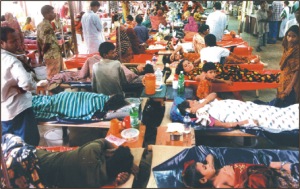
Hundreds of diarrhoea patients are under treatment at the International Centre for Diarrhoeal Disease Research, Bangladesh (ICDDR,B) yesterday as the waterborne disease rampages in the fallout of the floods that ravaged two-thirds of Bangladesh. PHOTO: STAR |

