After deluge, seed crisis plagues Narsingdi farmers
Reaz Ahmad, back from Narsingdi
Badly hit by the monsoon deluge thousands of Narsingdi farmers now find it difficult to recoup the losses due to a looming seed crisis pushing the seed prices to an exorbitant level. The worst flooding of recent years has ravaged large tracts of farmlands in the vegetable-rich Narsingdi causing a Tk 96 crore loss in ruined vegetables and aman seedbeds, according to the statistics compiled by the district office of Department of Agricultural Extension (DAE). Now that the government is pursuing a post-flood agricultural rehabilitation programme in a meagre way, majority of the flood-affected small and marginal farmers remain out of its bound and find it almost unbearable to manage high-priced seeds for fresh plantation. At Joshor Bazar in Raipura, long bean seeds were selling at Tk 140 a kilogram, up from Tk 80 in normal time, Abu Taher Munshi, a vegetable farmer of Nayachar village, told The Daily Star yesterday. Munshi, like other flood-hit farmers whose homesteads also had gone under the floodwaters destroying the seeds preserved at home, now ill-afford to buy them from the market. Prices of bean, bitter gourd and cucumber seeds also marked a steep rise, by at least 50 percent, making post-flood life even more difficult for farmers who hoped for an immediate drive to recover from the losses in lost crops and vegetables. Seed seller Amir Ali at Sirajnagar in Raipura told The Daily Star, "Last week I sold bean seeds at Tk 120 a kilo, compared to last season's price of Tk 60 only." Ali regretted selling up his entire stock and the missed opportunity to make more quick bucks as the same bean seeds are now selling at a much higher rate of Tk 160 a kilo. Abdul Hye Mridha, a vegetable grower of Brahmandhi village under Shibpur upazila in Narsingdi, invested Tk 20,000 to grow summer vegetables on a three-bigha land, but the July deluge damaged the whole lot. "If the standing vegetable plants could withstand the floodwaters, I could reap a harvest and sell the same at Tk 60,000 within the next one month," bewailed Mridha. Deputy Director of District DAE Office Bipad Vanjan Das told The Daily Star ripe summer vegetables in 11,223 acres out of a total 12,585 acres of land were totally ruined by the flood. Besides, aman seedbeds in 3,476 acres out of a total 5,121 acres and broadcast aman crops on 6,795 acres out of 8,452 acres suffered complete damage. Bipad said the government's agricultural rehabilitation programme could provide help in terms of free seeds and fertilisers to a maximum of 35,550 farmers, though the official figure put the total number of flood-affected small and marginal farmers in Narsingdi at 138,951. Again, of the 35,550 beneficiaries, official sources said only 13,500 farmers could expect free seeds of aman (5 kilograms each) and fertiliser (25 kilograms each) in the current month. The vegetable farmers would have to wait for at least two more weeks to get the government's seed help and the other farmers would get the input assistance only in the winter season.
|
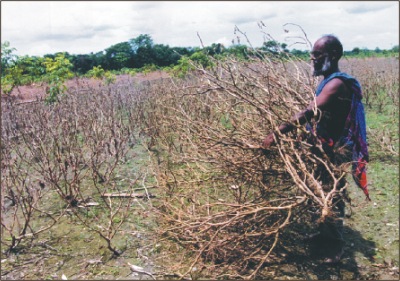
Abu Taher, a farmer of Nayachar village in Raipura in Narsingdi, clears the withered remnants of aubergine plants from his farmland ravaged by recent floods, as he prepares for fresh planting to make up for the loss. PHOTO: AKM Mohsin |

