Colour of youth, graffiti of youth
Harun ur Rashid
The emerging periods have seldom been 'happy times' for different trends of art. 'Expressionism', 'Impressionism', 'Surrealism', 'Cubism'--just name any of them, all were subjects of sour criticism and rejection when they came into being. However, all these practices later proved to be the products of genius experimentations. One such genre of painting is 'graffiti', which rose in the West in the face of an extremely antagonistic atmosphere. The harsh tone has, however, become somewhat understated in many countries and graffiti is now being considered an artistic expression.Young photographer Sajal Khaled is currently holding an exhibition of images of such colourful and 'youthful' graffiti he has seen in Germany. Colourful because graffiti is always a display of bright and burning colours like red, blue and yellow. And youthful because, painted generally by youths--mostly teenagers, graffiti depicts the thoughts and artistic innovations, protests and rages, hopes and dreams of the young generation. Rightly titled Colour of Youth, the exhibition at the Goethe Institut was supposed to be inaugurated by Dr Humayun Azad. But the saddening demise of this versatile writer and linguist lead to a change. Renowned photographer and ornithologist Enam-Al-Haque opened the exhibition. Having originated from the Latin word graffito, meaning 'illustration', graffiti is originally a calligraphy-based art form, which demonstrates popular sentiments about different issues. In the early 1950s, some Hispanic bands in Los Angeles and Mexico used to write the names of their groups on walls. The 1970s saw the use of the method for political purpose, namely demonstrating propaganda of political parties. From this practice arose a method called 'Pochsca' in Paris by spraying paints on paper-cut letters. It was during this period that spray paint was invented which made graffiti more popular because of its swiftness. In the 1980s, the letters in graffiti began to acquire 3-dimensional effects--an aspect that made the display more attractive. The attraction was further enhanced in the 1990s as graffiti began to incorporate figures of humans and other objects. Graffiti is quite like the writings on walls in our country. The differences between the two are: the walls in Bangladesh mostly display political slogans or election related propaganda, while graffiti depicts views on more universal topics. Again, while ours are mere calligraphy, graffiti entertains more graphical aspects like objects and human figures. Despite the artistic nature of graffiti, the harshness towards this new art trend, however, came to such extremity as to brand it as an act of crime--more precisely, an act of 'vandalism'. The reason was that the graffiti artists--mostly in their adolescence--used public as well as private properties, such as the walls of sidewalks, houses and subways. The situation has, however, changed much at present. The German government now often commissions artists to paint graffiti at select places. Sajal's photographs show one such five-storeyed building in Dresden wearing a huge graffiti work on its façade. Graffiti generally expresses popular views on issues varying from world politics to Internet hazards. One such graffiti on political personalities features the 'ugly faces' of former Iraqi president Saddam Hussein and the US president George W Bush. Graffiti is often influenced by what it is painted on. Sajal's photograph depicts one such graffiti painted on an electrical power room. It displays various electrical gadgets like heater, sewing machine and television--all of which are run by electricity. Sajal's endeavour is no doubt welcome, as he brings this curious art form to Bangladeshi viewers for the first time. The 24 photographs, however, seem few in number. Also the photographs are not large enough to clearly reveal the aesthetic value of this graffiti. The exhibition runs till August 24.
|
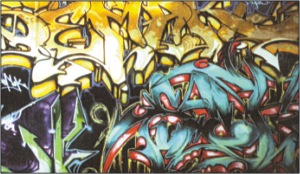
The calligraphy in graffiti has acquired 3-dimensional effect over the years |

