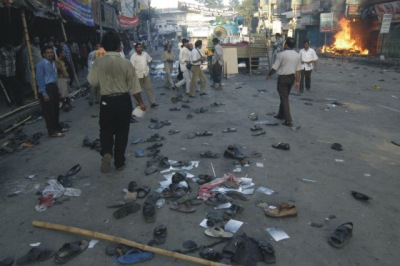
Bomb carnage in Bangladesh: All victims are secular
Nazrul Islam
The latest well-orchestrated attempt on the Awami League leadership by raining sophisticated grenades on August 21 exposed the vulnerability of the security of the people as well as the country.The idea that the people of Bangladesh are moderate and would never tolerate extremism, a contemplation of an optimistic section of our politicians, members of civil society, and intellectuals, I think, got a tremendous jolt after the August 21 incident. In this piece, I will try to examine the characteristics of the perpetrators and their likely political inclinations, if any. The August 21 blast was not the first bomb blast in the country, but of course the deadliest one that had a mission to annihilate the entire leadership of a party responsible for dividing a country into two pieces and spreading secular ideologies. The bomb-blast spree started in Bangladesh with Udichi blast in Jessore in 1999. Subsequently, bombs were ripped through Ramna Batamul, Narayanganj Awami League office, CPB meeting at Paltan, Awami League meeting in Bagerhat, Ahmadiyya Mosque in Khulna, Christian Church in Gopalganj, a fair in Satkhira, cinema halls in Mymensingh, the shrine of Hazrat Shah Jalal in Sylhet (twice), a shrine in Tangail, Awami League meeting in Sunamganj, cinema halls in Sylhet, a market in Sylhet targeting Awami League leader and Mayor of Sylhet, and the latest at Bangabandhu Avenue in Dhaka. All these blasts are not isolated incidents, rather inter-linked, well managed and well harboured by various agents. If we analyse the targets of the above blasts, one thing that is crystal clear is that all the targets have almost identical characteristics i.e. the victims were either secular in ideology or supporters of left-leaning parties or believers in a religion other than Islam or believers in a moderate or heterodox type of Islam. Among the victims, Awami League is a centrist political party having secular ideology, CPB a leftist secular political party, all the shrines of the country are the places of reverence for the secular-minded people, cinema halls or mela are also the entertainment places of secular-minded people. Suppose the perpetrators of the blasts fall into either of the two groups: one group comprising the centrists having left-leaning tendencies plus the leftists i.e. secular in character, and the other also the centrists but having rightist tendencies plus the ultra-rightists i.e. non-secular in ideology. Remember, since the Udichi blast, not a single attack has been made on any of the centrists having rightist tendencies or the ultra-rightist political parties, organisations, institutions, or bodies. Here the friends and foes are clear. The secular forces are the enemies of the perpetrators while the non-secular are friends. It is clear from the above inference that the masterminds behind the blasts mentioned above are non-secular in ideology. Many quarters, particularly those who oppose secular ideology, believe Awami League carried out the attacks. One should not outright brush aside such possibility. The government's attitude in this regard is also not unknown to people. After the bomb blasts at cinema halls in Mymensingh, some renowned intellectuals and persons having secular views were quizzed and thrown behind the bars. An Awami League leader of Sylhet is still in prison following the recent second blast in Sylhet. But here we can examine the chances of the involvement of Awami League in the blasts in reference to a number of elementsthe number of attacks, their targets, and the capability of carrying out the attacks. Firstly, if Awami League is the perpetrator, its prime objective is to shift the responsibility on others, especially on BNP. If the proposition of the anti-secular group is taken into consideration, then the question arises, how could it be possible for a party to kill scores of its own supporters by hurling bombs just to shift the responsibility on to others? One or two such incidents might be considered (for the sake of argument), but when the number is many and the victims sometimes are the entire leadership of that political party, the hypothesis stands simply dismissed. Secondly, look at the targets. At the beginning the attacks were targeted to common people and gradually shifted to high profile people, including the British High Commissioner, Suranjit Sen Gupta, Mayor of Sylhet, and Sheikh Hasina and other senior leaders of Awami League. The preliminary attacks were unspecific. Those were like practice sessions. After achieving ample experience, they started aiming at specific targets. And their ultimate mission is to exterminate the main secular forces of the countryAwami League. To accomplish the objective, they launched the August 21 attack, but the Creator miraculously saved the Awami League leadership at the cost of 19 dead and hundreds injured. Thirdly, if Awami League has the capability of launching such attacks, as the anti-Awami Leaguers claim, they surely then would have carried out at least one or two attacks on their enemies, especially after suffering the repression and oppression meted out to them after the October 2001 general elections. But in reality, none of the non-secular groups has so far come under such attack by any quarter. So, it would appear that Awami League does not have the capacity to carry out such bomb attacks in the country. Among the secular forces Awami League has a wide-range of supporters and base at all levels. If any element of the secular force wants to do anything (good or bad) it needs approval/support of Awami League. Similarly, we can say that Bangladesh Nationalist Party (BNP), having rightist tendencies, has an extensive base and supporters throughout the country. The ultra-rightists cannot survive or do anything without the endorsement of the BNP. The support may be from high-command level, local level, or personal level. If we look back, we would find that Jamaat-e-Islami is rehabilitated in Bangladesh by BNP, Freedom Party was a creation of Ershad, Ghatak Dalal Nirmul Committee was fostered by Awami League, and so on. Suppose, BNP was not directly involved in any of the bomb attacks. Earlier, we deduced that there was no chance of involvement of Awami League and other secular forces in the carnage. Then only the ultra-rightists are left as the possible perpetrators. These ultra-rightists have little footing in the masses and it seems improbable that they could carry out any operation without the support of a big force. So, it is possible that as a political party BNP may not have any direct connection in the bomb attacks, but would it be unreasonable to suggest that it does not seem likely that the masterminds would be able to accomplish their tasks without the assistance of some elements with ties to the BNP? Involvement of foreign agencies in the bombings has so far been set aside, but the high-tech grenades used in the August 21 attack and their similarity with those used in the Indian Parliament bombing clearly suggest that such agencies might be active on our soil. Huge quantity of arms and ammunition hauls on several occasions also suggests that one or more groups in Bangladesh are good receivers of sophisticated arms. After the August 21 carnage, the BNP leadership has been seeking help of Awami League to find out ways and means to stop such incidents. Awami League President Sheikh Hasina is being persuaded by various quarters to sit with Begum Khaleda Zia to resolve the crisis. but does Khaleda need any help from Hasina in this regard? If she is sincere in stopping recurrence of such incident in the country, she can do it on her own as the chief executive. Hasina has nothing to do with the bomb attacks as no secular force is involved in the act. She also has no influence on the rightists, the suspected masterminds of the attacks. The immediate task pending in front of Awami League is to devise ways and means to protect Sheikh Hasina and other senior leaders. The enemies failed on August 21. But it was just a beginning. They will go a long way to fulfil their mission if the current circumstances are not reversed. Nazrul Islam is a journalist and environmentalist.
|