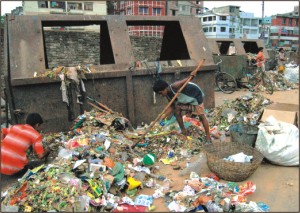
Dustbin-stench smacks air, poses health risks
Mizanur Khan
Dustbins set up to free the city from pollution are posing health hazards, residents of different areas said.The stench emanating from these containers make living quite unpleasant. "Dustbins were set up to keep the city clean but they have turned into a key source of pollution," said Farzan Ahmed, a Dhanmondi housewife. "These bins do not help keep the city clean but made the surroundings dirtier and repulsive," said Shobhan Sarkar, another resident. Health experts said trash left in the open for long cause diarrhoea, malaria, gastro-enteritis, cholera, hepatitis B and other infectious diseases. "The toxicity from the waste is so overpowering that trees surrounding the bins wither long before their life span," said Dr Mizanur Rahman of Dhaka Shishu Hospital. Some residents are not careful and conscious when disposing of trash. Dirt is dumped anywhere, but in bins. Street urchins scatter dirt hunting for treasure strewing rubbish all around. Residents also said Dhaka City Corporation (DCC) cleaners do not empty the dirt from these containers on time, but dirt is left to decompose on its own -- an allegation brushed aside by a DCC high official. Ibrahim Hossain, owner of a teashop few metres from a dustbin at Farmgate, said cleaners do not collect garbage regularly. "Garbage accumulated for two to three days affect my business as the stench keeps customers away," he said. "It is not only our responsibility. Dwellers should dump litter in bins instead of throwing it anywhere they wish," said Sohel Farouquie, DCC's chief conservancy officer. "We are aware of the situation and are planning to reduce these containers, as they are a hindrance to society," he added. A traffic police officer accused DCC officials of ignoring their duties and said: "It is impossible to stand here without a mask, even for a while." More than 4,000 permanent dustbins were installed at different points in the city and 400 portable metal containers were set up for effective waste management. A study by DCC states that residents of Dhaka generate more than 3,500 tonnes of garbage a day in the dry season, of which 80 percent is organic and over 4,500 tonnes in the wet season. DCC officials said fund constraints and labour shortages are the reason all garbage cannot be collected and the rest is left to rot. "An international study states that three cleaners are needed to collect waste produced by 1,000 people. We have only 6,500 workers serving more than a million residents," Farouquie told Star City. In February, the DCC installed wheeled containers in the New Market area on trial to make waste management convenient and effective. "We hope to install 50 more wheeled-containers around the city within the next two months. Areas will be more clean and hygienic as these containers can hold a larger volume and disposal is convenient. Furthermore this will save time and money," the officer said. The DCC now uses open containers for garbage removing. Cleaners carry garbage in wheelbarrows to roadside containers. Manual transportation makes the area around containers unclean as the garbage in wheelbarrows is dumped on the road and the hauled into containers. The DCC has recently undertaken a pilot project in two wards as part of waste management to continue through February. "We have involved the community in the project and hope it will work," Farouquie said. "We have to ensure scientific garbage collection and disposal system. According to the plan, garbage will be accumulated in only two or three places at a particular time a day. If the plan succeeds the city will be free of open dustbins," Farouquie added.
|