Offering immunity to WB to hurt country's interest
Politicians, academics, economists, lawyers say
Star Business Report
Politicians, academics, economists and lawyers yesterday urged the government not to pass any bill in the parliament that will give immunity to the World Bank (WB).They also urged organisations and individuals to take the government to court if it gives legal immunity to the multilateral donor agency. "What will we do if any of the World Bank projects poses any threat to our environment or any other fields?" asked Muzaffer Ahmed, a former professor of the Institute of Business Administration of Dhaka University, at a meeting in Dhaka. Saptahik 2000, a weekly Bangla magazine, and The Innovators, a trust, jointly organised the meeting titled 'The World Bank and The Question of Immunity' to raise voices against the government move. In the first week of July, the Cabinet approved a draft bill to offer legal immunity to the bank by seeking an amendment to the International Financial Organi-sations Order 1972. The bill styled as International Financial Organisation (Amendment) Bill 2004 is expected to be placed during the upcoming parliament session, sources said. The WB sought such immunity following a case filed by its former Bangladeshi official Ismet Zerin Khan on August 6, 2001 after she was sacked from the organisation. Participating in the discussion, GM Quadir MP criticised the government for drafting the bill. He said the government is obsessed with the idea that it cannot run the economy without the support from the World Bank and therefore it does not want to confront with the bank. The Jatiya Party (Ershad) lawmaker also urged people to file case against the government if it passes the proposed bill. Moinul Islam, former president of Bangladesh Economic Association, said the World Bank assistance is not essential to run the country. "As a student of economics, I say that Bangladesh can move without the bank's assistance," he added. Hasanul Haque Inu, president of Jatiya Samajtantrik Dal (JSD-Inu), said although the WB provides a little amount of money for the country's development, it always try to influence Bangladesh's policy-making process. Anu Muhammad, a professor at Jahangirnagar University, said as the bank has realised that its activities are harmful to people in many cases, it now seeks immunity from legal proceedings. Presenting a paper at the meeting, Rashed Al Mahmud Titumir of The Innovators said the bank fails to bring significant changes in the fields it works for. According to him, despite WB presence in Bangladesh after the country's independence, the country has found it difficult to achieve a faster rate of poverty reduction. Still 49 percent of the total population live below the poverty line and 19.98 percent suffer from hardcore poverty, he said, adding that the gap between the rich and the poor has also widened. According to organisers, they invited a representative from the World Bank to attend the meeting but none came to join the meeting. Hafiz Uddin Khan, former advisor to the caretaker government, and MM Akash, a professor of economics at Dhaka University, among others, spoke at the meeting.
|
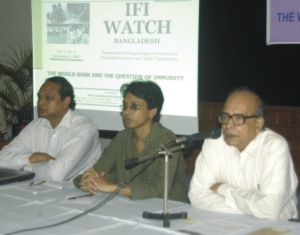
Muzaffer Ahmed, a former professor of the Institute of Business Administration of Dhaka University, right, Golam Mortoza, executive editor of Saptahik 2000, middle, and Rashed Al Mahmud Titumir of The Innovators, left, are seen at a meeting jointly organised by Saptahik 2000 and The Innovators in Dhaka yesterday. PHOTO: STAR |

