Dotta on celluloid
Another Sharat Chandra novel to hit the mini-screen
Harun ur Rashid
Another popular novel of Sharat Chandra Chattopadhyay (1876-1938), Dotta, has appeared on the celluloid. Two directors--AKM Firoz and Obydul Kabir--have made a telefilm on the novel. Scriptwritten by AKM Firoz and shot in betacam format, an edited version of the two-hour telefilm was premièred on September 3 at the Liberation War Museum.Set in the early 20th century, Dotta, meaning 'betrothed', is a simple love-story of two youths, who are engaged since their infancy. The betrothal was planned by their parents: Zamindar Bonomali proposed to his friend Jagadish the marriage of his daughter Bijoya with the latter's son Naren. As the two children grew up, Bonomali took the responsibility of Naren's education and sent him to England to study medicine. In course of time, as both the friends die, the betrothal remains unknown to Bijoya, although Naren is aware of it--he has the letter Bonomali wrote to his father. In the meantime, Rasbihari, another friend of Bonomali who also knew about the betrothal, hides it from Bijoya. He plans to marry her off to his only son Bilash and thus grab all the wealth of her estate. So, after Naren's return, the avaricious Rasbihari presents him to Bijoya as poor and indebted. However, Bijoya gets attracted to Naren gradually as she discovers his knowledge, kindness and simplicity. Finally, Bijoya comes to learn about the engagement and the two are wedded. The making of the telefilm is quite appreciable, except for a few directorial flaws. For example, while the costumes of Bijoya, Bilash, Rasbihari and others reflect the early 20th century, that of Naren does not. His short shirts and suits bear more of present time styles. Again, a microscope has been used in one scene. However, the microscope had not yet attained such advancement at that time as has been shown in the film. Two Nazrul songs--Dur dwipobashini and Khelichho e bishwa loye--quite suit the scenes they are used in. But the playbacks are perhaps from some recorded cassettes: no names of playback singers are shown in the credit lines. Real performances by artistes would have been more appreciable. Ahmed Rubel and Meem in the roles of Bilash and Bijoya have performed very well. The newcomer Kayes Arju in the role of Naren has also shown promise although at times his pronunciation lacks West Bengal dialect. Apart from these three, other roles have been performed by Khalilillah Khan, Jahanara, AK Azad, Barna, Anik and others. Produced by Dipshikha Films and shot at beautiful locations of Tikatuli, Kaliakoir and other places of Dhaka, the telefilm will go on air on the death anniversary of novelist Sharat Chandra Chattopadhyay in January. Sharat Chandra Chattopadhyay's literary works have always been favourite resources of the makers of films, telefilms and dramas. Devdas and other novels and stories of this immortal litterateur have been made on celluloid at different times in both West Bengal and Bangladesh. This new venture of Firoz-Kabir duo will surely enhance our film activities.
|
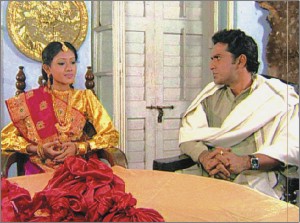
Meem and Rubel in a scene from the telefilm Dotta |

