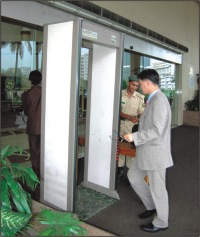
Offices shore up security as bomb threats send jitters
Avik Sanwar Rahman
Public and private offices are shoring up security systems with archway and handheld metal detectors in the wake of bomb blasts and threats over the last five years. The August 21 grenade attacks that killed 19 people have sent banks, hotels, museums, clubs, shopping malls, schools, non-governmental offices, cinema halls and private television and newspaper offices tightening security. Sonargaon and Dhaka Sheraton hotels, Standard Chartered, HSBC, Liberation War Museum, NTV and Bashundhara City are a few to name that have introduced metal detectors to deal with bomb threats. The secretariat, the nerve centre of administration, installed archway metal detectors after the AL rally attack sent a swell of panic across the country. Security systems are mainly imported from Finland, the United States and China. Group 4 Securitas Bangladesh Private Limited, a British-Danish security agency, imports archway and handheld metal detectors from Finland and CCTV (close circuit television) from South Korea. Doddhyscan Agency is the distributor of US Repiscan-branded archway and handheld metal detectors made in Finland and Alam Enterprise imports Garatte metal detectors from the US. Chinese metal detectors are also up for sale in the market. "Security concern has heightened this year, increasing demand for security equipment in the last three months," said the marketing manager of a security agency. "We sold 25 archway and 300 handheld metal detectors last year. This year, the sales of security systems rose about 20 percent. We are running short of equipment as the demand grows," said Selim Chowdhury, managing director of Group 4 Securitas. The security measures for five-star hotels include checking car boots and searching for bombs underneath with car search mirror -- the steps Sonargaon and Dhaka Sheraton hotels took in the fallout of the Iraq war. "We have sought help from the armed police and Rapid Action Battalion," said Mahbubur Rahman, public relations manager of Dhaka Sheraton. "People express annoyance as they say they are being treated like suspects, but they have to understand these measures are taken for their safety as well and not to harass them," he said. Banks are among some other installations that went on alert after the Iraq war. "We are keeping backup information of our clients for retrieval in the event of any attack," said a high official of Standard Chartered. "We have introduced metal detectors and bag check. Customers are not allowed to use mobile phones inside the building," he said. The demand for security guards is up, as private and public institutions, including schools, tightened security in and around the premises. "Scholastica school also took the services of security guards," the Group 4 Securitas marketing manager said, adding some private schools are now asking for CCTV and metal detectors. Businesspeople tend to use armed guards and bodyguards for security, as the abduction of Jamal Uddin Ahmed Chowdhury and the killing of other businessmen spread panic. "Businessmen want armed bodyguards, but we are unable to do that as security agencies are not permitted to have arms licence," Selim said. As many as 139 people were killed in 16 bomb blasts in the last five years, with an explosion at a Udichi cultural function on March 6, 1999 which killed 10 people, followed by Ahmadiyya Mosque in Khulna on October 8, 1999 that killed eight. The other major bomb blasts include an attack on a Communist Party rally on January 20, 2001 that killed seven people and the Ramna Batamul carnage that killed 10 people two and a half months apart.
|