Cyber cafés go slow under sharp police watch
Syed Tashfin Chowdhury
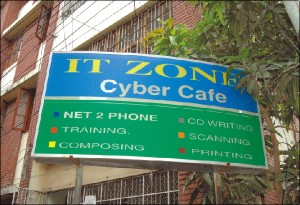
Cyber cafés in Dhaka have called on their clients not to use their services to threaten political leaders and foreign organisations here, a concern that came to a head after an email sender threatened to kill Leader of the Opposition Sheikh Hasina."We have been pushed to the extremes with recent problems crippling the cyber café business," said Masudur Rahman, member secretary of the Cyber Café Owners Association of Bangladesh. Substantial losses and lack of technical skills at the heart of cyber café business have forced many cafés into closing down or shifting to other business. The police and intelligence agencies are mounting a sharp watch on the cyber cafés in the wake of email threats to Hasina, Prime Minister Khaleda Zia and her son Tarique Rahman. Partha Saha, the internet user arrested on charge of emailing a Bangla daily a threat to kill Hasina, was using a computer and the server of Heart.net cyber café. Partha was a regular visitor to the café and its owner says he was using the café services to apply for jobs. The email could be tracked down since the café was using the connection of Global Technologies, an internet service provider (ISP) that maintains log files that help track emails. "We had only a register of browsers to identify the users," said Kazi Sujauddaula, owner of Heart.net. But the police have asked the café owners to keep detailed identifications from their customers in the wake of the email treats. "We may lose customers because of police watch," said Suja, adding: "We are now keeping their names and whereabouts." Most customers of these cafés are teenagers who come to cafés to chat using microphones and webcams and browsing websites. Couples also frequent cafés, which provide cubicles for privacy of customers who browse porn websites. "It is apparent that the customers, feeling guilty of their own activities, may stop coming to the café s if they are asked to give identifications and addresses," said Suja, who dreads close scrutiny of intelligence agents that may lead to the closedown of his café. Following up on the ordeal that Heart.net is currently in, other cafés are trying to solve such potential problems. Most cyber cafés have posted notices requesting browsers to refrain from emailing threats. Masud shared with Star City a bitter experience he had in running a cyber-café, CNS Online, which was shifted into ISP business, a year ago. As Masud put it, an unknown customer emailed al-Qaeda network. The email remained unnoticed by the local administration but was soon tracked by the Federal Bureau of Investigation (FBI) in the US. "There was a huge mess and the FBI quizzed my brother, a US resident," Masud said, adding: "But we were fortunate as it was soon found that the email was actually a prank.” The cafés are running the risk of incurring huge losses. Internet service providers have to pay $4,500 per up and down mbps, which translates into a huge amount when converted into the local currency. Most cafés have cut their charges to the minimum to attract customers and increase profit. During the morning slot from 10am to 3:00pm, the charges are Tk 15 an hour and Tk 10 Taka for half an hour. During the evening slot from 3:00pm to 11:00pm, the charges are a little higher at Tk 20 an hour and Tk 15 for half an hour. The cyber-café trend in Bangladesh began with the British Council's café and the Blue Planet in 1998. The third in this line was CNS Online that started its operation in 1999 and is currently an internet service provider. About 260 cafés operated in the city two years ago, but half of them closed down. "With the arrival of much-anticipated optical fibre technology, the struggling cyber cafés may drag themselves out of the slump," Masud hoped.
|