Beslan tragedy
Syeda Sultana Razia, PhD, Former President, Canadian Society for Peace in Chechnya
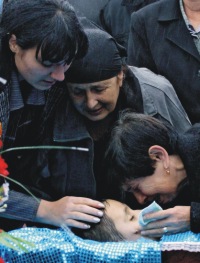
The harrowing episode of hostage taking of hundreds of Children in Beslan has drawn the attention of the international community to the often-neglected armed conflict in Chechnya. The hard line policy of President Vladimir Putin, a man who believes more in statistics than in human lives, is turning the conflict into the most serious human rights crisis in Europe's recent history.The conflict, starting back at the end of 18th century with the Russian conquest of the North Caucasus, has two governing factors: one is the animosities rooted in a historical, ethnic, religious and territorial claims, the other is the struggle for geo-strategic space and vital resources like oil and oil pipeline routes. The current conflict began at the end of the cold war, when Chechnya declared independence from the Russian Federation after a number of regions managed to gain independence from the collapsing Soviet Union in 1991. The result was a horrendous war in which Kremlin renewed the tragedy that has dragged on for centuries. The war led to death of almost 100,000 Chechens (from a total population of about 1.23 million) and has created another 100,000 refugees. In the last one decade while the Chechens saw their people imprisoned, tortured, yielding to the temptation of terrorism, the Russians found their soldiers killed in thousands, returned secretly to the cemeteries. Yet the international community remained silent. British Journalist Lindsey Hilsum notes: "… Chechnya is a shameful example of western leaders refusing to confront another government on human rights abuses and war crimes because, in the end, strategic and political issues matter more. Chechnya is complex and dangerous and miserable, and we just don't care enough to try to make a difference." The US stand on this conflict is still a mystery. It is being accused of giving green signal to the rebels to destabilise the region in order to ensure more control over the natural resources on one hand, giving tacit support to Russia to carry on the "war on terrorism" on the other. In the mean time the conflict between Islamic democracy and Islamic militancy within Chechnya complicates the situation further. No matter how many times prominent Islamic scholars issue fatwa against terrorism or leading Muslim political experts suggest not to confront Russia for strategic reasons, Russia's heavy hand on Chechnya will intensify the resistance and continue to breed terrorism.
|
. PHOTO: AFP |

