'Most of all it is birds that inspire me'
Hashem Khan elaborates on his works
Fayza Haq
Hashem Khan is the head of the Oriental Department, Dhaka University. Some decades back, sitting in the Department of Fine Arts, he talked articulately on subjects such as his background, sources of inspiration, work, style and subjects. Asked to comment on the nostalgic element in his works, paintings and collages, he said that the kites, boats, flowers and grass are an integral part of his artHis fairly recent solo exhibition at the National Museum and Shilpangan centred on these subjects along with his latter day works on the freedom fight. He not only uses collage, water-colour and oil, but goes in for mixed media too. 'I have recurrent memories of Chandpur, and these form the basis of my best known work,' he said. Hashem's childhood was spent in the villages along the banks of the Meghna and Dakatia. The colonial rulers sailed these rivers and these bear a history which goes back to centuries. It is on this aspect that he stresses. Hashem is a firm believer in the dictum 'Life is a journey'. He loves to dwell on minute details and-- like most of our major artistes--always harks back to our rich cultural past. In his work, he focuses on the vast green fields, the idyllic flora and fauna. Other sources of inspiration are the farmers and boatmen, along with the village maidens. 'Most of all it is birds that inspire me,' he said. He recalls freeing pet birds so that they could soar into the sky. This was even in the face of opposition from his childhood friends who goaded him to keep them in cages. Some of Hashem Khan's works try to capture the bird's eye view of our countryside. As he says,' The countryside can be seen in the eyes of the birds that soar and glide over the numerous villages.' He is a proponent of the view that birds should live in the rural areas, even though there is not necessarily a logic behind this belief. Much later, as a student of Fine Arts, he went into experiments of the bird's eye view, as he felt that the entire world could be seen in a bird's eye. As he flew kites at his childhood, and in his later years, when he met and read Shahid Ali's Jibrailer Dana about a child sending messages to angel Gabriel about his secret sorrows, he continued in his pursuit for preserving that subject in repeated art works. Asked if his works may be classified as impressionistic, despite the breaking of images and simplifying of the basic images (important factors that belong to the modern period in art history), Hashem agreed that this writer's opinion was correct. At present, he said, he is also doing abstracts, serious assails in abstract forms, as seen in his last two solos at the National Museum and Shilpangan. 'What I do depends on my mood; I chose my styles accordingly. I work in a single room in my house, which is converted into a studio, listening to Uchangasangeet and Rabindrasangeet. I do not plan ahead necessarily and work with various paintings which I put before me on the floor or the easel.' Dwelling on his overseas stint as a student in Shantiniketan, and later in places like Germany and Czechoslovakia, Hashem Khan said that the one to one relationships, the exchange of ideas and views that ensued, were enriching. Asked about the phenomenon of lobbying in the Department of Fine Art, Hashem admitted that this is prevalent. However, he felt that the prime responsibility of current day students of art was to promote art in Bangladesh. To his credit, Hashem Khan has held numerous exhibitions both joint and solo, at home and abroad. He occupies the ranks of the truly talented artists of our country.
|
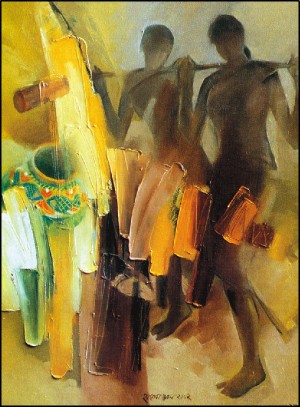
Hashem Khan's works hark back to our rich cultural past |

