Maintaining eastern aesthetics
Satter, an artist to reckon with
Fayza Haq
Abdus Satter, head of the Department of Fine Arts, DU, asked to speak about his development of Oriental Art works of minimization and symbolism, sitting in his office (with the steady downpour outside the window of his office), held forth with clarity and precision. He explained the symbolic and geometrical forms that have entered his basic Oriental Art creations of late. He spoke of the development of his style, likes and dislikes. He also explained that presently, with all the bureaucratic papers to handle in his office, he hardly has the time or inclination to paint at leisure, which is what he actually wants to, like most creative artists. Abdus Satter said that his basic education was in Oriental Art at the Art College. 'At that time, the department had been shut,' he said. He adds, 'The then principal stirred up a storm in a tea cup and refused to let me continue from pre-degree stage. However, I was hell bent on continuing in my line of studies. This was in 1968. Hashem Khan was then appointed as my teacher: thus you got a scene of a single pupil sitting at the feet of a sole teacher. The training that ensued was one beyond comparison, considering that we were then in the sixties. Oriental Art has a charm of its own. It has a delicate and romantic basis, which is undoubtedly lyrical and beyond compare. 'Take for instance, Abdur Rehman Chughtai's paintings: they are unique. The cave paintings at Ellora and Ajanta too present statuesque figures with delectable details of limbs, gazelle eyes and tapering fingers. The impact is truly rhythmic, as if the figures are taken from some poet's dream. When I do my water-colours and prints, I try to maintain the eastern aesthetics. Later, I studied at Shantiniketan for two years, studying painting and print-making, with Somnath Hor and Shukhomai Datt. I was then, also inspired by Ram Kinkar . 'Returning to Bangladesh, I created a printing machine of my own, with bits of metal parts, which I obtained from the mechanics of Old Dhaka. This was no easy task, but I don't regret this, as I desperately need it for progress of my work. Eventually this basic print machine helped him participate in graphic arts competitions the world over. This included cities in USA, Europe, Russia, and Asia.' Talking about his education and the teachers who had inspired him, Abdus Satter said that he went to USA on a Fullbright scholarship, at Washington DC and Pratt Institute, New York. There, Satter said, he met artists from around the world, exchanged ideas with them, and worked with them. The education there was naturally of a higher standard than what is found in Asia. There the works of individual artists were often hung up and then followed artistic criticism and each artist had to defend his work. This was like defending your thesis ever so often, so that it made you confident and mature at an early age. Again the lectures included slides, Satter said, about 200 in some, so that the message of the professors left an indelible mark on his mind. Regarding his shifting over from the lyrical style to the more modern symbolic and simplified ones at present, Satter added that that he has shifted in style but not in themes. Satter maintains romantic images in his more recent water-colours and oils. Satter is indeed an artist to reckon with.
|
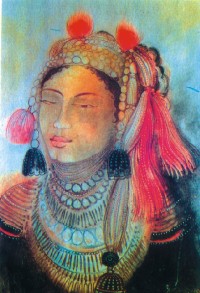
Tribal Girl, watercolour |

