Bush wins after Ohio drama
Agencies, Washington
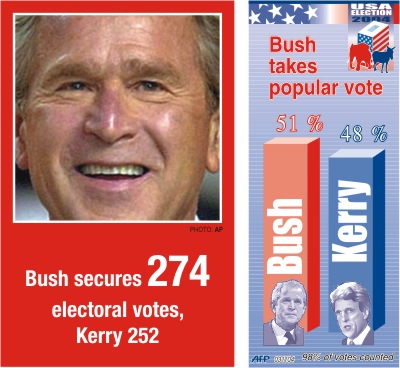
President Bush won four more years in the White House, pocketing a quiet concession from Democrat John Kerry that closed out a loud and long campaign fought over the war on terror and the economy. "Congratulations, Mr. President," the Massachusetts senator said simply in a call that lasted less than five minutes and followed Kerry's decision not to contest Bush's lead in make-or-break Ohio. The victory gave Bush a new term to pursue the war in Iraq and a conservative, tax-cutting agenda --and probably the chance to name one or more justices to an ageing Supreme Court. He also will preside alongside expanded Republican majorities in Congress. The GOP gained four Senate seats and led for a fifth. The party bolstered its majority in the House by at least two. His re-election secure, Bush planned a midafternoon appearance before supporters in Washington. By pre-arrangement, Kerry was speaking first to a hometown crowd in Boston to conclude a campaign that came achingly close to success. Ohio's 20 electoral votes gave Bush 274 in the Associated Press count, four more than the 270 needed for victory. Kerry had 252 electoral votes, with Iowa (7) and New Mexico (5) unsettled. Bush was winning 51 percent of the popular vote to 48 percent for his rival. He led by more than 3 million ballots. Officials in both camps described the conversation between two campaign warriors. A Democratic source said Bush called Kerry a worthy, tough and honorable opponent. Kerry told Bush the country was too divided, the source said, and Bush agreed. "We really have to do something about it," Kerry said, according to the official. White House spokesman Scott McClellan said Bush told Kerry, "I think you were an admirable, honorable opponent." Advisers said the campaign just wanted one last look for uncounted ballots that might close the 136,000-vote advantage Bush held in Ohio. An Associated Press survey of the state's 88 counties found there were about 150,000 uncounted provisional ballots and an unspecified number of absentee votes still to be counted. In a dispute that evoked memories of the prolonged election recount in Florida in 2000, questions about provisional and absentee ballots in Ohio had delayed the final outcome of the presidential election for hours. Ohio's 20 electoral votes had been the final hurdle to Bush winning an Electoral College majority of 270 votes after a divisive campaign that focused on the war in Iraq, the battle against global terrorism and the economy. Republicans also celebrated expanded majorities in the House of Representatives and the Senate in results likely to build the president's mandate and ease Bush's conservative agenda in Congress. Bush himself planned to declare victory before long. Republican Party Chairman Marc Racicot said the president put it off temporarily as a courtesy to Kerry, "to allow the opportunity to look at the situation in the cold hard light of day." Bush, who watched the results in the White House with his family, including his father, former president George Bush, said early in the evening he was confident of victory. "We're very upbeat, thank you," Bush told reporters. "I believe I will win." Kerry, watching the results in his hometown of Boston, did not make an appearance before reporters but sent out aides to predict a win. Demonstrators were due to take to the streets of Columbus later on Wednesday, to protest against what they called voter disenfranchisement and a repeat of the botched election in Florida in 2000. The Florida race was ultimately decided by the US Supreme Court, which gave the election to Bush. Continuity was the result elsewhere in government, with the GOP padding its Senate majority knocking out Democratic leader Sen. Tom Daschle of South Dakota in the process and easily hanging on to the House. That will be the state of play on Capitol Hill for the next two years, with the chance of a Supreme Court nomination fight looming along with legislative battles. Glitches galore cropped up in overwhelmed polling places as Americans voted in high numbers, fired up by unprecedented registration drives, the excruciatingly close contest and the sense that these were unusually consequential times. The country exposed its rifts on matters of great import in Tuesday's voting. Exit polls found the electorate split down the middle or very close to it on whether the nation is moving in the right direction, on what to do in Iraq, on whom they trust with their security. The electoral map yesterday looked much like it did before; the question mark had moved and little else. Bush built a solid foundation by hanging on to almost all the battleground states he got last time. Florida fell to Bush again, close but no argument about it. And so all eyes turned to Ohio, where Democrats clung to hopes that provisional ballots would overcome Bush's lead. Bush's relentless effort to wrest Pennsylvania from the Democratic column fell short. He had visited the state 44 times, more than any other. Kerry picked up New Hampshire in perhaps the election's only turnover. In Ohio, Kerry won among young adults, but lost in every other age group. One-fourth of Ohio voters identified themselves as born-again Christians and they backed Bush by a 3-to-1 margin. A sideline issue in the national presidential campaign, gay civil unions may have been a sleeper that hurt Kerry who strongly supports that right in Ohio and elsewhere. Ohioans expanded their law banning gay marriage, already considered the toughest in the country, with an even broader constitutional amendment against civil unions. In all, voters in 11 states approved constitutional amendments limiting marriage to one man and one woman. For all the stumping in Ohio, nine in 10 voters had made up their minds before the last week, and they favored Bush. True to his reputation as a strong closer, Kerry performed better than Bush among those who decided late. In Florida, Kerry again won only among voters under age 30. Six in 10 voters said Florida's economy was in good shape, and they voted heavily for Bush. Voters also gave the edge to Bush's handling of terrorism. In Senate contests, Rep. John Thune's victory over Daschle represented the first defeat of a Senate party leader in a re-election race in more than a half century. Republicans were assured of at least 53 seats in the coming Senate, two more than now. Republicans made gains in the House, too, where they had prevailed for a decade. Nationwide, with 98 percent of the precincts reporting, 112 million people had voted up from 105 million in 2000. Bush was ahead in the popular vote, which he lost in 2000, and independent Ralph Nader was proving to be much less of a factor this year than four years ago. Exit polls conducted for The Associated Press and the television networks by Edison Media Research and Mitofsky International suggested that slightly more voters trusted Bush to handle terrorism than Kerry. A majority said the country was safer from terrorism than in 2000, and they overwhelmingly backed Bush. The dollar lost ground and US Treasury prices firmed early on Wednesday after the uncertainty in Ohio made the market more cautious about betting on a Bush victory.
|