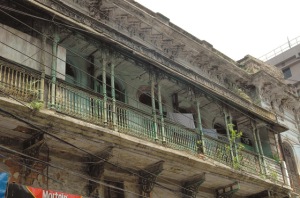
687 buildings vulnerable to collapse
Sultana Rahman
Urban planners have classified at least 687 buildings mostly in Old Dhaka as vulnerable to collapse, with 165 of them as creakiest from age and decay. The Urban Planning Department (UPD) of Dhaka City Corporation (DCC) tagged the buildings as risky after it wrapped up a survey on 10 DCC zones in early November. Mild earthquakes or heavy rains may knock down the most vulnerable 165 buildings in Siddique Bazar, Shankhari Bazar, Tanti Bazar and Sutrapur. Some of them may cascade down on impact if heavy trucks blast their way near these age-old buildings, Sirajul Islam, DCC's chief town planner, said of the vulnerability of the structures. The building No. 81 in Shankhari Bazar that caved in killing more than 11 people and injuring about 40 others in early June was among the risky buildings. The incident echoes the collapse of the house No. 10 in Shankhari Bazar that killed seven people in 1982. The deaths of neighbours frightened thousands in Old Dhaka as most are living in age-old buildings. Although they are willing to replace old buildings, they are in a dilemma as each building has a number of owners. After the July incident, the government took the issue seriously and formed a secretary committee on vulnerable buildings, which includes DCC, Rajuk, deputy commissioner and land, law, public works and housing and finance ministries. Rajuk and Dhaka District Commissioner's office are carrying out two more surveys to identify the risky buildings. "Most land owners tend to construct buildings at a low cost, which often makes the structures fragile," an engineer said. "Rajuk is the authority to check the situation but ignored it for long." The 1983 Dhaka City Corporation Ordinance authorises the DCC to demolish vulnerable structures and ask owners to bring the structures down. If the owners do not comply with, the DCC will then destroy them and the owners have to pay the cost of demolition with annual tax. The vulnerable structures are between 30 and 350 years old and vary from one-storey to multi-storey buildings. Some modern multi-storey buildings were found vulnerable as well. "Most buildings in Dhaka hardly have space between them. If a vulnerable structure collapses, it could prompt a chain reaction with adjacent buildings at high risk. It could have catastrophic consequences," a DCC official said. "Many structures are very old and seemingly vulnerable, but the quality of engineering, soil and geological conditions kept them strong," said the chief town planner. "We will submit the survey to the mayor soon and the secretary committee on vulnerable buildings will decide on the next step," Sirajul said. Town planners said old buildings are the heritage of a nation which should be protected as the other countries do. "Dhaka's old buildings are about 200 years old and could be part of our national heritage and tourism," said a senior architect in the Architects Institute of Bangladesh (AIB). AIB will organise a presentation on old buildings on November 9 at the DCC, with a spotlight on the importance of old buildings and its aesthetic aspect.
|