Dhali Al Mamoon
Aiming to change the structure of the society through installation works
Ershad Kamol
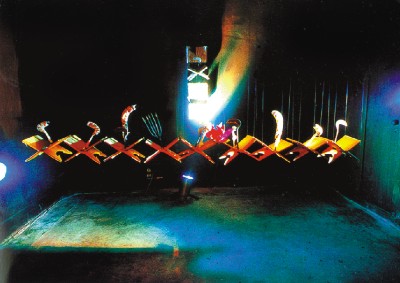
Dhali Al Mamoon began his promising career as a painter and printmaker in the early 1980s. Mamoon's most significant paintings and graphics of the preceding period display an inclination towards traditions and myths of this region. They are delineated in a language derived from the western experiences. The mythical character of Behula is a source of inspiration for him and he assimilates the allegorical reference and the present context in a symbolic manner in his two dimensional works.Currently, Mamoon has shifted gear. His transformation as an explorer of the more contemporary expressions of visual language, such as installations and video presentations, is a comparatively recent phenomenon. Associate Professor in the Department of Fine Arts at Chittagong University, Mamoon has changed his style, medium and language. Commenting on the reason behind the change, Mamoon says, 'A conscious development of perceptual sensitivities along with a conceptual maturity transforms an artist. A committed artist with a creative impelling force continuously outgrows himself with new experiments in medium, style and language. 'The art of installation has various aspects. On the one hand, it has more communicative advantage over displays hung on a wall and has given a new dimension to art. On the other hand, its advantages of diversity of materials and modes of expression have attracted me,' he adds. Mamoon's works are a sharp weapon against religious bigotry. He says, 'I have respect for the pious. However, it is true that modernism has produced much ideology and philosophy but none of them have been as successful as religion. I approach art keeping this reality in mind.' In his installations, he prefers a more metaphorical expression, using materials and items which are at the same time used for violence and day to day household activities. Installations are three dimensional expressions. Sometimes Dhali's installations appear to be a photography studio. An interesting story remains behind each of his idea. Mamoon says, 'When I visited the Khirkee Mosque, not used for prayers at present but is still a piece of beautiful architecture, I decided to bring this architectural splendour to my studio. This idea reminds me of my photography studio during my childhood. I have recreated this studio through this painting to blend with my memory. In the studio of my memory there were opportunities to dress in the colonial-style costumes. So, I have drawn a bridge between my concept and my socio-political condition, as I believe that an artist possesses a healing power to redress the damage of the society through his or her artistic venture. My medium is painting. I want to focus on the disorder in the structure of the society. I draw ideas from newspaper photographs.' So far Mamoon has presented six installations at home and abroad. His first installation is on the death of Sanjay, a victim of the brutal attack by the fundamentalists. In this project, he has used wooden logs wrapped in bandages and soaked in antiseptic which points to the victim's death and his struggle for life. Supported by Sanjay's childhood photographs, his art materials and used items, the presentation succeeds in capturing his death and his living existence, and at the same time pointing at the death of an innocent by the fundamentalists. Mamoon's current project Water is Innocent is somewhat abstract and complex. Set against a remote context, it is executed in a metaphorical language. This display puts spectators in a challenging position, and for them the encounter seems unexpected, as the whole presentation boils down to a fantastic spectacle. Mamoon has presented an amalgam of paintings, sculptural elements, photographs, texts, video, sound effects, flowing water and kinetic movements of some sculptural forms with the help of power driven motors in this project. About his Water is Innocent project, Mamoon says, 'The plight of the ethnic people of Chittagong Hill Tracts is the theme of my present work. Water has become one of the overpowering elements in their lives. It is water that had once drowned their land and dislodged them in many different ways. This followed the construction of the barrage producing hydro-electricity over the last five decades.' Dhali Al Mamoon has participated in many exhibitions at home and abroad. His talent has earned recognition. In 2000 he won the National Award for the best work of the year conferred by the Bangladesh Shilpakala Academy.
|