Rokeya Day
Recalling the legend in women's education and empowerment
Parvez Babul
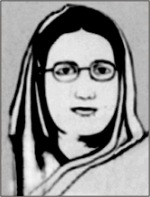
BEGUM Rokeya, the legend in women's education and empowerment, was born on December 09, 1880 and died on December 09, 1932. We observe December 09 as 'Rokaya Day'. Begum Rokeya got a lifespan of about 52 years only. The generous contributions of Begum Rokeya in educating, empowering and enlightening women in our country can be regarded as a milestones in any age. Begum Rokeya was born in an aristocratic family of Pairaband, Rangpur. Her family name is Roquiah Khatun but she is well known as Begum Rokeya. Begum Rokeya's elder brothers studied in Saint Xavier's College, Calcutta; but Rokeya and her elder sister Karimunnessa were not sent to school! Yet, Rokeya learnt Bangla and English with the help of her brothers at home. Her brothers and sister also inspired her in writing. Begum Rokeya founded in 1916 Anjuman-e-Khawatin-e-Islam (AKI) or the Muslim Women's Society to make women aware of their rights. That organisation was in the forefront of fighting for women's education, employment, empowerment, legal, political rights etcetra. AKI defrayed the cost of education for a large number of women and arranged marriages for many poor women. It gave shelter to orphans, destitute women and extended financial help to widows. It also established some businesses for women to earn and be self-reliant. AKI contributed greatly towards the development of Muslim women in Calcutta, bracing negative comments and allegations from conservative people. Begum Rokeya is remembered for her liberal thoughts, secular outlook and powerful writings. In some of her writings she advocated for a concerted effort by women and men for social development. She also wrote on contemporary politics encouraging women's participation. Begum Rokeya's writings called upon women to protest against injustices and break the social barriers, which are discriminations against them. Her Abarodhbasini (The Secluded Women) is a spirited attack on the extreme forms of purdah (veil) keeping women away from others that deterred their lives. Her other noted works include Matichur, Padmarag, 'Sultana's Dream', which she later translated into Bangla as Sultanar Swapna, etc. Begum Rokeya wrote poetry too. Many of her poems and essays were published in different renowned magazines. Begum Rokeya wrote on a wide range of subjects: social prejudice, adverse effects of purdah system, women's education, repression on women, women's rights and on women's awakening. She also wrote against the tradition of childhood marriage, polygamy etc. In 1898, Rokeya got married with deputy magistrate Syed Sakhawat Hossain. Sakhawat Hossain was liberal, progressive and encouraged his wife Rokeya to study both Bangla and English. He also inspired her to read literary works from home and abroad. Begum Rokeya started writing with the inspiration of her husband. Unfortunately her husband died on May 03,1909. Begum Rokeya had two daughters, but they died in infancy. Begum Rokeya could never sit idle and kept working for women's education and emancipation. The Muslim women of Bengal at that time were backward, neglected and oppressed. She realised that women could be freed from their shackles only if they were educated and became economically independent. On October 01, 1909 she started a school for Muslim girls at Bhagalpur, India with only five students! She named the school after her husband, Sakhawat Memorial Girls' School, but later she had to move to Calcutta. At Calcutta she set up Sakhawat Memorial Girls' School on 16 March 1911 with only eight students. But through the untiring efforts of Begum Rokeya the school was gradually upgraded to Middle English Girls' School and High English Girls' School. The school was shifted to different places because of the increase in the number of students and some other reasons. The school got its permanent address when it was finally shifted to its own house. By that time Begum Rokeya had been running the school for twenty-four years overcoming, various obstacles. She made the school one of the best seats of learning for Muslim girls, a learning that was beyond the imagination of the girls of that time. In a word, Rokeya made the 'impossible' possible standing against the negative norms of a society. With relentless hard labour she was able to bring her fellow women to face the realistic world to live in a positive way. She worked hard to convince Muslim families to send their daughters to school. She went from house to house, motivated the parents that education was good for girls and the precondition of their empowerment. But it's a matter of great regret that in our country, the motherland of Begum Rokeya, still about half of the women population are illiterate! In 1901, literacy rate was 5.6 per cent but within 100 years we could not be able to increase the literacy rate up to 100 per cent! This is why we should recognise the problems and take necessary, time-appropriate initiatives to make all of our women literate. Government, NGOs, civil society and each one of us should start and take the responsibility to teach at least one illiterate person from today as a part of observing of Rokeya Day. Parvez Babul is an NGO activist.
|
|