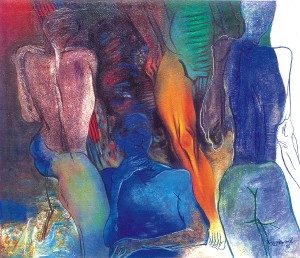
'Harmony of colours is fundamental to my composition'--Mansur Ul Karim
Ershad Kamol
Mansur Ul Karim's artistic per-ception has grown and developed over the years. The exceptional natural beauty and the life of the rural Bangladesh permeate his canvases. His bond with the humans and their surroundings shines through the predominant colours. Nature and humans intermingle to announce their interdependence and they seem inseparable in his works. The paintings of Karim, a Professor of Fine Arts at Chittagong University, are neither mere expression of love for nature, nor any subjective or metaphysical reflection on it. Nature is not even used as a mere background for the human figures in Karim's canvas. Inspired by 'A passionate sense of deep physical and spiritual bond that exists between nature and man', Karim strives to illustrate the truth in simple terms. 'My works from the 1980s onward use bold lines, textural surface and economical use of colours, and human figures, birds, animals and what I call my "organic forms" that crowd the intensely interactive space,' says Karim. Initially he used to follow the common abstract mode, while playing along with the trend of the 1970s. But reflection of the sociopolitical turmoil of the time was a mainstay. 'A number of artists swerved from that trendy path in search of newer artistic means, as we were willing to confront the reality that we lived in,' says Karim. Paintings took a new shape in the hands of these artists and Karim certainly played a pioneering role in the transformation of the abstractionists into exponents of social consciousness. They received a good grounding in abstraction, that is why their works combine the spontaneous embodiment of structures, colour plains with recognisable abstractionist elements. Karim, like his friends, started his career in the '70s and was inclined towards the abstract trend of the time. 'And then I came out of it, and went back to nature,' he asserts. Harmony of colours, for Karim, is fundamental to his composition. Of men, women, and nature, the great unity that is expressed in subtle, deep, or even bright shades of colours, come together to form the final imagery. With the poetic play of scratched lines, his images are lent its most concrete element of all -- the suggestive humans and natural elements. He applies minute details in certain areas, adding to the atmospheric beauty. Karim stresses that his female figures are the embodiment of nature. The main subject matter of his work is the rural scenery of hilly Chittagong, and he draws an analogy of those curvilinear landscapes with the female form, though a few male figures also surface in his paintings. Karim says, 'I always imagine the sky in multi colour. It has a great impact on my artistic work. The female form, sometimes alone sometimes in a group, as a rule, merges with the background that depicts nature.' 'I have rediscovered the magic of light and shade. My palette has became sparse over the years, but the principle of chiaroscuro--the way light and shade are shown, the contrast between light and shade--remains the same' he adds. Most of Karim's paintings are done in acrylic; some are even done in oil. His signature surfaces in his use of large, spatial colour fields marked by their contrasting shades. His recent works were done in two different series. Six of the paintings constitute the first series. Titled The Six Seasons, they exude visual energy. The rest of the paintings have no such theme to express, but also are related. The series is on our time, which he sees as 'arid, aimless, and oppressive.' The paintings have banished nature altogether: even in The Six Seasons series, nature is a mere suggestion, not shown in terms of colours that are compatible with the mood of particular seasons. Colours used are bold and splashy -- but not in a celebratory sense. There is hardly any presence of nature in the rest of the works. Instead, figures occupy the central space; the strong use of color is something new for Karim and shows his penchant for innovation. In the paintings where human figures are prominent, lines are minimised and figures are marked by a simplicity that allows for a direct interaction with the viewer. Karim has left a blank space in many of these paintings and painted the background white to 'see if the open space communicates his thoughts and feelings to the viewers.' Done in 2003, these paintings describe the cruel turns of events and express the pains of living in these uncertain times. In The Freedom Fighters Now, for example, the focus is on the plight of the freedom fighters. Their mutilated appearance emphasises their helplessness. Karim has especially concentrated on the eyes. The eyes of the human figures do not focus on any particular object or sight, but bear the lost looks of the denizens of a world devoid of humanity. In Those Seven, all the figures slant in one direction, showing the oppression of uniformity. In another, which shows only human feet pointing endlessly at an uncertain destination, the main concern is the loss of direction in our times. Mansur Ul Karim has never faced dejection in his more than three decades of artistic work. Karim says, 'I am always inspired by the work of painter Rashid Chowdhury, whom I consider my mentor. When I do not get any new idea, I take cues from his paintings. That is why I could go on for so many years without any interruption.' Mansur Ul Karim has received many awards. Of those he considers as the most remarkable the Grand Award at the 8th Indian Triennial International, New Delhi organised by Lalit Kala Academy, India in 1994 and the Grand Award at the 6th Asian Art Biennale organised by Bangladesh Shilpakala Academy in 1993. Moreover, he has taken part in many solo and group exhibitions at home and abroad.
|