Patha natok played an important role during our Liberation War
Cultural Correspondent
Cultural activists in our country played a major role during our Liberation War. A well-known case is the stellar contribution of the cultural activists at the Swadhin Bangla Betar Kendra. Another popular medium, patha natok (street theatre), was also active at the grassroots level in the Independence struggle.To generate awareness on social issues among the audience through some explicit messages, patha natok has been practised in Bangladesh and other parts of the world for many years. During the Pakistani period, as full-fledged theatre was still nascent in Bangladesh, drama devotees basically staged patha natok. Their aim was to rouse public opinion against the oppression of the then Pakistani regime. As their aim was to grow awareness, the diction of the patha natok was easy and communicative. Patha natok practice in those days was not organisation-based, rather it was centred on a few people. Mannan Heera, the current President of Bangladesh Patha Natok Parishod (BPNP), says, 'Patha natok practice in those days was Dhaka University-based. Muneir Chowdhury, Hasan Imam, Kamal Lohani, Ramendu Majumdar and others were the pioneers in organising and staging street plays. Muneir Chowdhury's play Kabor was a sharp weapon against the Pakistani regime.' From 1969, this genre of theatre, along with Gono Sangeet (songs of the masses), became a powerful tool against the oppression of the Pakistani regime. Patha natok in those days basically dealt with some important political issues, which motivated the students as well as the common people to march for the Independence. And from the late '70s, Mannan says, 'Cultural activists of Dhaka and Chittagong regularly staged patha natok on trucks, which ultimately became a process of recruiting freedom fighters in 1971.' In the refugee camps, cultural activists regularly staged patha natok to encourage the frontline fighters for the Liberation War. Even today the performing art of patha natok has a universal appeal. It is staged regularly in the open air to protest against evil as well as to enable people to fight for their rights.
|
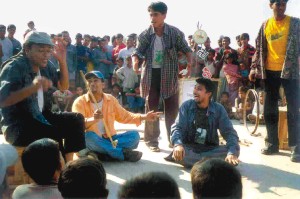
Young theatre activists present a street play |

