New Year Special
Memorabilia of the greats
Stellar Bangalees and their luminous works
Harun ur Rashid
Watching the December 16 entry by eminent educationist Abdur Rashid Tarkabagish in his diary, or the invitation card of Nobel laureate economist Amartya Sen's wedding, or the epitaph of Hasan Hafizur Rahman written by the litterateur only the day before his death gives one an overwhelming feeling. It is almost like meeting these historic Bangalees in person at the Bangalee Shamagra Gallery of 235/2 Elephant Road. 'An endeavour to preserve the works of the best Bangalees', the personal enterprise of young Tariq Rahman Shourav, surely contributes to the over-all effort of recreating the history of the country.Situated in 2000-square-feet space, the gallery displays portraits, memorabilia and documents related to a large number of Bangalees. Besides, a considerable collection of books, photographs and video tapes also add to the effort of preserving the memories of these Bangalees whose immense contributions have shaped the country for its future generations. Having started its journey in February 2004, the gallery accommodates portraits of 52 Bangalees under four sections: (1) Language-Education-Literature, (2) Society-Politics-Economics, (3) Music-Theatre-Film-Sports, and (4) Science-Architecture-Fine Arts. 'Obviously, there are many more personalities--rather than only 52--who have contributed to these fields,' explains Tariq. 'As a starter, we have decided to display the pioneers only, but gradually we will include all other Bangalees in our exhibition. And we have included West Bengal also in this regard--for, we are actually carrying on the legacy that many intellectuals from the neighbouring Indian state had established for us,' he adds. The portraits feature Ishwar Chandra Bidyasagar, Michael Madhusudan Datta, Bankim Chandra Chattopadhyay, Rabindranath Tagore, Dr Muhammad Shahidullah, Jibanananda Das, Kazi Nazrul Islam, Raja Ram Mohan Roy, Mohammad Akram Khan, Rokeya Sakhawat Hossain, Dr Muhammad Ibrahim, Jahanara Imam, Sher-e-Bangla AK Fazlul Haque, Maolana Abdul Hamid Khan Bhashani, Sheikh Mujibur Rahman--the Bangalees who, with their revolutionary ideas, reformed the society and education, the language and literature of the counry. Besides, there are portraits of great musicians--the mystic Lalon Shah and Hason Raja, king of folk music Abbasuddin Ahmad, world renowned classical maestro Ustad Alauddin Khan; artists--first Bangalee Muslim painter Kazi Abul Kashem, Shilpacharya Zainul Abedin, Patua Quamrul Hassan and SM Sultan; magician of football Abdus Samad and record setting swimmer Brajen Das; first Bangalee film activist Hiralal Sen, first Bangla filmmaker Abdul Jabbar Khan, martyred Zahir Raihan; scientists Kudrat-E-Khuda and Jagadish Chandra Basu; and architect FR Khan. The most interesting exhibits are, however, the large memorabilia collection--manuscripts, diaries, original works and personal belongings of personalities. 'Regarding these mementos, we have always been very strict at displaying only the original pieces--no photocopy of manuscripts or letters, which we have often been offered,' says Tariq. 'From renowned photographer Amanul Haque we have collected letters of Satyajit Ray, manuscripts of poet Sufia Kamal and Sikandar Abu Zafar from their family sources,' he informs. Among the interesting collections are the driving license of Munier Choudhury, the share certificate of Iqbal Films that produced the first Bangla film Mukh O Mukhosh, and the chess board used by Dr Kazi Motahar Hossain. An important document is the Mujibnagar government's certificate to swimmer Arun Nandi who swam for a record 90-hour duration in 1971 with an aim to draw international attention to the ongoing war of Bangladesh. There are also the script of Satyajit Ray's Kapurush O Mahapurush, musical notation prepared by Ustad Alauddin Khan, manuscripts of Rabindranath Tagore and poet Subhash Mukhopadhyay. Two very interesting pieces are filmmaker Alamgir Kabir's 16mm movie camera and a Dotara of musician Abdul Latif. The collection also contains an oil painting by the first Bangalee Muslim artist Kazi Abul Kashem. Moreover, there are copies of numerous newspapers and magazines of the past including Sawgat, Dhumketu, Begum, Probashi, Shamokaal, the Ittefaq and the Shangbad. The gallery also has interviews of eminent Bangalees recorded on videotape. 'So far we have interviewed veteran journalist Obayed Ul Haque, singers Firoza Begum and Abdul Latif, poet Shamsur Rahman, Begum editor Nurjahan Begum, artist Kazi Abul Kashem and a few others. We hope to make arrangements soon so that visitors can watch these interviews here,' says Tariq. The gallery also has plans for publications especially biographies of the great Bangalees. It has already published a book on Jahanara Imam. 'Gradually, the gallery will be transformed into a museum in future. Meanwhile, we will carry on our quest for enriching our collection and executing our different schemes regarding preserving and spreading the light that our Bangalees' works emit,' says a confident Tariq.
|
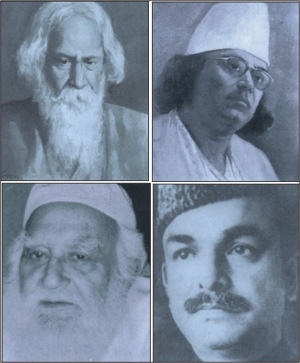
Clockwise: Rabindranath Tagore, Kazi Nazrul Islam, Habibullah Bahar Chowdhury & Abdur Rashid Trakabagish |

