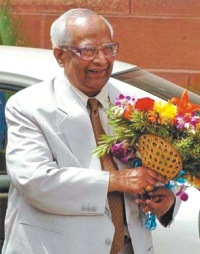
In Memoriam
J.N. Dixit : Diplomat, patriot, secular nationalist rolled into one
He was part of 1971 war history
Afsan Chowdhury
J.N. Dixit, one of India's leading strategic policy analysts who passed away Monday while serving his government in an official capacity was a robust patriot. Many called him a hawk on most matters Indian and few ever saw him back down in the seminars and fora that he attended to argue the case for India's international polices. He was often belligerent and sometimes aggressive and many of his own countrymen disagreed with his stance or views but he had India's interest foremost in his mind.That didn't make him a Hindutva ideologue as some seem to have thought in Bangladesh. If anything he was an equally robust champion of old fashioned secular politics at home and abroad. The Nehruvian India was able to consume all his interest and he never hesitated to say so. We encountered at several workshops and seminars on conflict resolution and South Asian politics and I had a fair idea about his thoughts on neighborliness. And if I came away feeling that he was only India's man and not exactly a South Asian pan nationalist, he was also a man who pursued that goal with integrity and forthrightness. Our most frank moments were spent discussing India, Pakistan and Bangladesh in 1971. The man who took care of the refugees in 1971
At a seminar held in Delhi 2001, which was oozing with Indo-Pak bonhomie, J.N. Dixit stood out in that crowd as a cold eyed realist. He didn't win friends but a few arguments and stood for a consistent line on bilateral matters rather than blowing hot and blowing with each season. He of course came from a generation that had seen the splitting of their India, the birth of a new country based on religio-ethnic arguments and his rancour against what he saw as historical injustice was genuine. For him and many of his kind, the 1971 war provided an opportunity to right that wrong and JN Dixit as a significant officer of the Indian officialdom felt that India had done the right thing. When we met in his Gurgaon residence in 2002, he had just joined the Indian National Congress party and some eyebrows were raised in surprise. Some thought that his position wasn't far away from the BJP mind. We met on a summery autumn day and he welcomed us in his study, offering the traditional glass of cold water as they always do in Delhi followed by an invite to have lunch. We talked shop about Dhaka politics, his books and then the BBC tape recorder was put on as he easily chatted about that historic year. Mr. Dixit had, among other duties, been in charge of managing the refugee deluge. "I was once with Prince Sadruddin Aga Khan, the UN High Commissioner for Refugees and told him to go inside a tent himself and ask about the identity of the refugees. Most were Muslims in that camp. In fact the proportion of Muslim refugees in 1971 were higher than Hindus." "Are you saying that more Muslims went to India?" "Of course. What did you think?" "I thought more Hindus went. That's what everyone says." "That's not true. If that were the case our whole point would have been a participation in a communal war that is Muslims killing Hindus, Indian agents. The Bangladesh war was a nationalist war and the Pakistanis were killing Bengalis. It was against a people, not against a community. That was our whole argument." To be honest I was stunned. This was the first time I had heard this position. It was when I kept getting the same information from other Indian leaders and policy makers that I realised that there may be gaps in our knowledge of the matter. Later I played the interview in the BBC series supported by other comments of the same ilk made by others as well. BBC London also felt that this point deserved to be heard. A moral war, India's 'jehad'
But what came across very intensely was that to Dixit and others of his own kind, it was a war that was against the communal divide of 1947. It was therefore a moral war, the closest to a 'jehad,' however odd it may sound in the present context. Dixit's comments on international politics made some of his contemporary positions clear too. There was no illusion in 1971 that India had permanent or real friends. The Russian and the US position were both products of convenience and to him and his South Block (Ministry of Foreign Affairs) friends, India had to chart its own ship with care and craft. "We knew that the 7th fleet didn't have any battle orders so we were not worried. I confirmed this later as well in conversations with US leaders. But we couldn't have gone on fighting as the Soviet couldn't apply the veto in the UN indefinitely. We had to act fast." Some have however felt that the US had some real nasty ambitions but no formal records have yet surfaced exposing any major warfare design of this superpower. Having stayed silent throughout the early period of mass killing, the US probably had greater interest in Pakistan surviving than whatever happened to the strategically uninteresting eastern part. The nation-statist
It was this equation that J.N. Dixit understood very well, the essential loneliness of a nation state in a sea of other ruthless nation states. India had to look after itself and for that he would advise and act accordingly. No diplomacy here for the diplomat. Dixit essentially followed this logic and if in his various south Asian postings he came across as a bit abrasive, he didn't apologise. To him, he had seen enough to know that arguments are lost by the weak and he was not going to lose any. While we in Bangladesh barely recall his stint here, a Sri Lankan friend described him as, 'the imperial viceroy of India.' Dixit was there at the height of the Tamil insurgency and Indian involvement. Popularity ratings were not for him. When he saw me to the door, full of courtesy and charm, he again indulged in small talk. He smiled at one point and said, 'the problem with you people is that you can't make up your mind whether to be a Muslim or a Bengali." I smiled and didn't argue. In many ways his parting words defined him, his own era and his vision. It was not an ethnocentric nationalism that he espoused but a political one. Nor could he appreciate the complexity of multiple identities. But for what he held dear -- secular state nationalism -- he was willing to go far. Our last conversation was on phone. I called him up to clarify the refugee issue once more and this time he was slightly irritated by my insistence. " I have told you what I know. If anyone can provide records let them do so. But I was in charge of the matter and I should know. "As a journalist I must do my job." He did his. He shall be remembered as one of the finest Indian diplomats and strategists of his time. And to us he will always be an Indian who played a significant role in the birth of Bangladesh. Afsan Chowdhury is a senior journalist
|