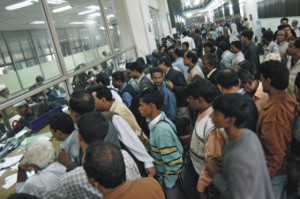
Heavy withdrawal ups call money rate to 50pc
Precautionary demand for money creates stress on liquidity: Bankers
Star Business Report
With the banks going on four-day vacation ahead of Eid, the call money rate yesterday hit 50 percent, a trend usually observed during the pre-Eid periods.Banking sources attribute the high rate of inter-bank transaction to bank customers who withdraw cash heavily from the banking sector. The demand, which economists term 'transaction and precautionary demand for money', creates a stress on the liquidity, bankers said. "The resultant factor of the large volume of cash being in circulation in people's pockets rather than being in the banking sector causes temporary shortfall with the banks." Therefore, quite naturally, the rate by which the banks exchange short term funds jump to higher levels, explained the banker. He said its only before the last Eid in November, Bangladesh Bank extensively used the Treasury bill Repurchase agreement (Repo) facility in order to maintain a stability of the rate in the market. During the last Eid-ul-Fitr, the call rate remained relatively stable, as the highest rate was 20 percent. The rate yesterday peaked at 55 percent among the non-banking financial institutions (leasing, insurance etc.) which are generally large borrowers from the inter-bank market. In the Repo mechanism, Bangladesh Bank supplies money to the banking sector in exchange of banks' excess Treasury bill held with them for a specified period. Bangladesh Bank supplied almost Tk 500 crore on November 9, 2004 through the Repo facility. However, the situation had changed since November last. Bangladesh Bank discontinued supplying funds in the banking sector through the Repo facility in the last week of December, a leading banker pointed out. "As a result, we saw a spike of call rate to 40 percent during the year-end on Dec 30 when banks window dressed their balance sheet by keeping excess money in central bank", he said. Suddenly on 15th of January, Bangladesh Bank accepted Repo at a higher rate of 10 percent than the usual range of 4.5 percent to 5.5 percent. To meet the demand from huge cash withdrawals, banks applied for Repo of Tk 770 cr on January18 this year, which was the last Repo auction before the Eid" the banker said, "However, the central bank accepted less than 1/5th of the bid amount and supplied only 140 cr through Repo, which was also at a higher rate." Because of this gap, call rates reached 50 percent yesterday and despite repeated requests from the borrower banks, central bank denied to hold Repo auction, the banker explained. He said that as a result, almost 90 percent of the transactions among banks as well as the NBFIs were settled between 40 percent to 50 percent. Before Bangladesh Bank decided to supply funds at 10 percent through Repo, most of the banks had closed their shortfalls at high rates. Looking back to last few years, Eid period could have justified an earlier communication to the banks. He maintained that it had been observed that since the beginning of December 2004, call rates edged higher than the previous ranges. "Higher call rate is an additional cost, which is finally being passed on to the investors and borrowers from banks." In this situation, banks increase their deposit rates to attract deposits which is again needed to be passed on to borrowers, he said adding that when a bank gives depositors 7 percent for their funds, the grossed up cost becomes around 8 percent because of the reserve requirements. Paying higher costs for depositors' money would force the banks to keep the lending rates higher, he observed.
|