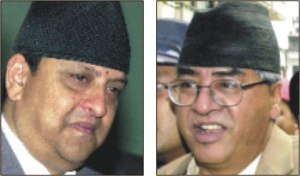
Nepali king sacks govt, slaps emergency
India voices grave concern, airlines suspend flights
AFP, Kathmandu
King Gyanendra dismissed Nepal's coalition government yesterday and enforced an indefinite emergency, igniting charges he had staged a coup in the Himalayan outpost battling a Maoist revolt. "I have exercised the rights given to the crown under the present constitution and dissolved the government in the larger interests of the people," the king said in an address on nationwide television. "A state of emergency has been enforced across the country," suspending all fundamental rights of citizens, state-run radio and television said. Gyanendra, who sacked prime minister Sher Bahadur Deuba for the second time in two years, pledged to "restore democracy and law and order in the country in the next three years." "For the larger interest of the Nepalese general public, the nation and democracy and people's fundamentals rights, we have decided to form a new government under my own chairmanship," he said. State radio said the king had suspended some articles of the 1991 constitution but did not say which ones. Article 127 allows the monarch to "remove difficulties in government". Political leaders accused Gyanendra, who ascended the throne after a palace massacre in 2001, of carrying out a coup. "The king's actions against the all-party government mark a state of coup against democratic practices," said education and sports minister Bimalendra Niddhi. The ousted prime minister issued a statement accusing the king of "a flagrant violation of the constitution of Nepal." "It is an anti-democratic step and we strongly denounce this act. This step has thrown the country into a grave crisis," he said. "Various political leaders including the prime minister and the secretary-general of the NCP-UML Madhav Kumar Nepal have been put under house arrest," Deuba added. The Nepali Congress Democratic Party-United Marxist Leninist voiced strong objections to its leaders being kept indoors. Deuba's party, the Nepali Congress Democratic Party, issued an appeal for broad opposition to the king's move "for the cause of the nation, democracy and constitution." The ex-prime minister's statement was handed out by party supporters to journalists waiting outside his residence where guards stopped visitors from entering. Witnesses and Deuba's supporters said several government ministers, particularly those from the Nepali Congress Democratic Party, were escorted away by security personnel to an unknown destination. Troops and armed police patrolled the streets and surrounded the palace and other key sites such as government buildings. Residents of Kathmandu reached by telephone said outgoing landline telephone and mobile phone links were cut. The Indian government voiced "grave concern" Tuesday after King Gyanendra sacked the government and declared a state of emergency in neighbouring Nepal. "These developments constitute a serious setback to the cause of democracy in Nepal and cannot but be a cause of grave concern to India," the foreign ministry said in a statement. The king accused political parties of "indulging in factional fighting." "All the democratic forces and political leaders should have united to protect the country's democracy," Gyanendra said in a half-hour speech. "Innocent children were found massacred and the government could not achieve any important and effective results. The crown traditionally is held responsible for the protection of national sovereignty, democracy and people's right to live peacefully," he said. Deuba had promised to hold long-postponed elections after the rebels, fighting to set up a communist republic, failed to respond to his mid-January ultimatum to talk peace.
|