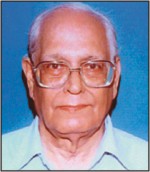
First death anniversary of Justice Debesh today
Staff Correspondent
Today is the first death anniversary of Justice Debesh Bhattacharya, a champion of democratic and human rights.The founder-president of Bangladesh Enemy Property Act Repeal Committee, he was also a presidium member of Bangladesh Peace Council and executive committee member of Bangladesh Nagarik Committee. Justice Bhattacharya was a member of the Gono Adalat (people's court) set up to try the war criminals of 1971 and chairman of the citizen's commission set up to investigate the Jagannath Hall tragedy of October 15, 1985. He was also a patron of Bangladesh Hindu Bouddha Christian Oikya Parishad, Bangladesh Puja Udjapan Parishad and Mahanagar Sarbajanin Puja Committee. Born on November 3, 1914 in a zamindar family of Ellenga, Tangail, Justice Bhattacharya obtained his Bachelor of Law degree from the University Law College, Calcutta in 1938, securing first class in all the three law examinations -- preliminary, intermediate and the final. He did his MA in economics from the Calcutta University in 1940 and joined the Mymensingh Bar in 1941. Because of his involvement in political activism, Justice Bhattacharya was put in jail by the-then Muslim League government as a security prisoner for about two years during 1949-50. Following his release from prison, he started his practice at the Dhaka High Court in 1951. He was enrolled as an advocate of the Supreme Court in 1956 and as a senior advocate in 1961. Justice Bhattacharya was nominated as a member to the Bar Council in 1960 and worked in this capacity till the coming into operation of the Bar Council Act, 1965. He was then appointed as member of the Rule Committee of the High Court. After the independence of Bangladesh, Bhattacharya was appointed as a judge of the newly established Bangladesh High Court in January 1972. He was elevated to the Appellate Division of the Supreme Court in June 1975 and retired from the bench in 1977. He proved himself to be an outstanding jurist and some of his verdicts have been historically precedent setting judgements. Justice Bhattacharya had published four volumes of essays and a book of poems. He had donated all his law books to the Supreme Court Bar Association Library. On the occasion of his death anniversary, rituals and distribution of food among the destitute have been arranged at his native village in Ellenga.
|