Exhibition
Bangladesh art captivates Delhi
Pallab Bhattacharya, New Delhi
Delhi glitterati turned up in huge numbers at the recent inauguration of the weeklong art exhibition of seven Bangladeshi artistes organised by the Society for Promotion of Bangladesh Art (SPBA) according to The Times of India.The exhibition of 43 paintings by Rokeya Sultana, Nasreen Begum, Dilara Begum Jolly, Kalidas Karmakar, Ranjit Das, Chandrashekhar Dey and Iftikar Uddin Ahmed covered a variety of subjects including nature, man-woman relationships, spirit of adventure, human tendency for nostalgia on a wide range of art forms like oil on canvas, watercolour, acrylic on canvas, mixed media and wood blocks. Iftiqar Uddin Ahmed's paintings explore "spaces of nature", the space created by man and the space created for imagination and his work is rich in symbolism. For instance, the pillar reflects strength, the wall symbolises limitations and land and sky are images of boundless space, explained the artist. Rokeya Sultana's paintings bring out the status of women in Bangladesh society and speaks of the need for freedom. They also focus on relationships between man and woman in a nuanced manner. "Women are predominant in my works as they are the most oppressed section of society," says the 47-year-old painter. However, she deals with women-related issues in a positive way, a trait she says she has developed during her training in Vishwa Bharati University in Shantiniketan. Sultana points out that the images of bird in her works symbolises freedom for women. For Nasreen Begum, whose work is mainly in watercolour, nature is her romantic space and she says her paintings reflect her own mood and the seasons. "My search is always through nature because human beings are a part of it," she says. She too depicts the status of women through the painting titled Cactus in which a cactus is shown growing on a head. "It exhibits how a woman has to keep smiling even when she is under a lot of pressure," says Nasreen Begum. Ranjit Das' paintings deal with the serious issues of life as evident in the gloomy face looking out of the canvas. Dilara Begum Jolly's works brings to life abstract images and inverted figures and Chandrashekhar Dey's depicts the place of nostalgia in human life. The exhibition at the Art Junction of Hotel Intercontinental near Connaught Place in Delhi was inaugurated by Satish Gujral, well known artist and brother of former Indian Prime Minister Inder Kumar Gujral. The latter was the chief guest at the launching of the book Bangladesh Art: A collection of Contemporary Paintings. The former prime minister, who is also a strong proponent of strong India-Bangladesh relations, said the exhibition provided an opportunity to bring the two countries closer through art. Among those present at the opening of the exhibition were former Jammu and Kashmir Chief Minister Farooq Abdullah, a regular face in Delhi's art and party circuits, and former Bangladesh Foreign Secretary Farooq Sobhan. The Society for Promotion of Bangladesh Art must be given credit for organising the exhibition, its maiden venture in the Indian capital. The display provided a glimpse into the rich artistic culture of Bangladesh and the depth and passion of the artists. Grameen Phone and GMG Airlines provided extensive support for the exhibition.
|
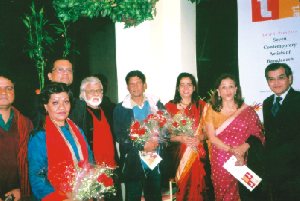
(L-R) Rafi Huque, general secretary of SPBA, Nasreen Begum, Elthem Kabir, chairman of SPBA, eminent Indian artist Satish Gujral, Iftikar Uddin Ahmed, Rokeya Sultana, owner of Art Junction Mrs Suri and Farooq Sobhan, former foreign secretary, seen at the opening ceremony |

