Kibria bhai: A personal tribute
Shaheen Anam
TO me Kibria bhai epitomised the cultured, educated, free thinking and poetic Bengali of an era which is fast disappearing. He stood out among many, a class by himself with his intellect, his sophistication and most prominently his pride in the Bengali culture. He competed with the best of that time and came out with flying colours. All his life he struggled and fought for Bengalis to hold their head up in pride and take their rightful place in the world. I met him for the first time in 1978 in Geneva where he was serving as the Ambassador. The occasion was our national Independence Day . The nature of the function, the kind of songs that were sung, his enthusiasm, everything revealed his love for Bangladesh, the Bengali culture and especially for Ranbindra Sangeet. I met him again in 1985, when my husband was posted to Bangkok at the UNESCO regional office. As an accompanying spouse, I stood in awe of this great man with such a distinguished career not only in Bangladesh but also in the international arena. This awe soon turned into admiration when I discovered his human qualities, his sense of fair play and his behaviour towards those younger than him. As I got to know him and the Bangladeshi community in Bangkok, I quickly realised that he and his wife, Asma Kibria (Iva apa) were the central figure around which our social world in Bangkok revolved. He wanted to bring us all together to share and enjoy our culture and most importantly our children to learn about our rich heritage and take pride in it. Both of them were instrumental in setting up the cultural organisation called "Purobi" of which all the Bangladeshis in Bangkok were members. Kibria bahi loved Rabindra Sangeet and no social gathering, either in his house or elsewhere, would be complete without after dinner music. He encouraged everyone to sing and his wife being a noted singer herself was our teacher. It was because of her utter patience, that even I dared to sing in those social evenings. No matter how we sang, Kibria bhai made it a point to praise us. He would say that since we are not professional singers, the spirit of singing is more important than the quality. It was not only social evenings in each other's houses that brightened our expatriate life. We celebrated our national days, pahela baishakh, etc. by organising grand functions at which we sang and our children would dance. Gradually we became so inspired that we started to stage dance dramas and plays. Our daughters learned dancing from Zubaida Latif (Panna apa) a well known dancer who gave so much of her time to teach our girls some beautiful dance numbers. Those memories are precious, filled with fun and laughter and through it all Kibria bhai was by our side. Such was the sporting spirit among us that even my husband agreed to participate in a dance drama as the key figure when Iva apa requested him to . Almost all of us would participate in these functions as artistes, a group of at least 30 to 40. The fact that there were hardly any audience to watch our much rehearsed programmes was not a factor. We just enjoyed getting together to celebrate anything, be it Ekushey or Victory Day or the first day of spring. I was always amazed how Kibria bhai, in spite of his busy schedule, would find time to not only attend these cultural shows, but also the rehearsals. In fact he would sit through these rehearsals, giving encouragement and advice. Perhaps many people do not know but he often participated in those programmes himself and sang along with us. Always a good sport, he would sing solo songs on our insistence and often recite poetry in Purobi funtions. However, the most beautiful picture in my mind is when Iva apa and Kibria bhai would sing a duet. One of the duets I loved was : e pare mukhor holo keka, o pare nirob keno kuhu hai. He was a wonderful family man who was proud of his son and daughter and adored his grandchildren. The fact that both his son and daughter have distinguished career was a matter of great pride for him. However, his relationship with his wife was what touched me most. He admired Iva apa and rightly so, for the many wonderful human qualities she possessed and for her talent. She being a well known painter thrived on the encouragement that he always gave her. Her work place in their house is a testimony to their relationship where it is set up in a way that she would paint and he would write his newspaper commentaries. I have often wondered how many couples of that age enjoy each other's company as they did. But this is a personal tribute and I want to say what he meant to me as a person. In Bangkok, while to everyone else I was Mahfuz Anam's wife, he treated my aspiration for a career with respect. He tried to help me when I started to look for a job and never failed to inquire how my job search was going. He was always ready to assist me as I was trying to reintegrate back in the professional world when we returned to Bangladesh after staying abroad for 14 years He genuinely believed in the economic emancipation of women and promoted the cause throughout this professional and political life. He believed that education for women was the key to their emancipation and pushed for this in his capacity as ESCAP chief and Finance Minister. I have had the privilege of discussing this issue with him often when attending seminars and workshops on women rights as chief guest. He said that he was always ready to allocate funds to projects that could concretely pull women out of the discrimination that they presently face. In the hundreds of meetings I have had with him, one thing that came out was his Bengali spirit. He loved everything about the Bengali culture. The songs, dances, poetry, plays, the food the pithas. He was Bengali to the core and a secular one at that. He abhorred the use of religion for political gain and was vocal in his criticism of anyone doing this. I wonder, if that is why he lost his life in such a brutal way! That someone so sophisticated in his ideas and thoughts should die in this way, brought back in a stretcher, his body torn and mangled, bleeding to death practically without medical attention is something that is impossible to accept, both by family and friends. We want the culprits of this heinous act brought to justice. The state owe this, not only to his family, but also to the democratic and freedom loving people of this country. As for me, I mourn his death from the depth of my being. He treated me with affection and respect. In a culture where usually the wife of an important person is treated in a dismissive or at best condescending way , Kibria bhai was different. He saw me as a person, not only as somebody's wife. He encouraged and inspired me to do better, to achieve higher goals. I will always remember him with deep respect and gratitude. I will remember him when I listen to his favourite songs. Outwardly he was a successful diplomat, writer, politician and international bureaucrat, deep inside he was a gentle romantic person. One of his favourite song was, hridoyer ekul okul dukul bheshe jai, hai sojoni uthole nayan bari. He once told me that this was the greatest love song ever written. That is how I want to remember him. Shaheen Anam is Team Leader, Manusher Jannyo.
|
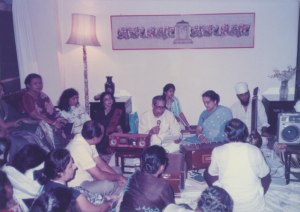
SAMS Kibria and Mrs Kibria at a Purobi function in Bangkok |

