Extracts of sacrificial cattle add to revenue
Faizul Khan Tanim
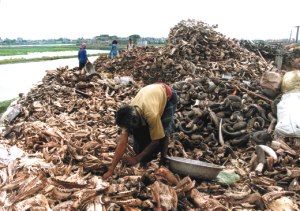
Business this Eid-ul-Azha soared with cattle organs and bones being valuable items in addition to the usual hide of the animals slaughtered during the festival. A Hazaribagh factory source said that an individual bone-collecting entrepreneur gathers around 20 tonnes of bones and organs each month, but the collection rises to 280 tonnes a month during Eid-Ul-Azha. The central accumulating place of most slaughtered animal bones was Hazaribagh tannery area, where one entrepreneur, Abdul Mannan Bhola Miah had collected 200 tonnes of bones and organs by himself so far. His turnover this year has been as much as Tk 150,000 as compared to last year's revenue of Tk 80,000, and claimed that this year's collection and sales have been the best so far, attributing the profits to a larger number of cattle sacrificed this year. This was possible he said as the price of cattle had been very reasonable. With the increase in salt (used for the preservation of hide) prices from Tk 250 to Tk 750 a sack of 75 kilograms (kg), the hide business could not do as well as expected, the cattle extracts -- bones and other organs -- business was a success. The Export Promotion Bureau (EPB) sources said Bangladesh earned about Tk 55.33 lacs in the 2003-2004 fiscal year by only exporting animal bones. Bones are dried and fed into machines. Big chunks are broken into smaller pieces, which are later is weighed and filled in sacks. Of the four categories of bone chips, Bangladeshi companies use two categories of small chips while the larger categories are exported. Vital organs such as gonads are exported to Myanmar where the demand is high. Horns are used locally for production of combs, melamine products, buttons, showpieces and other items. Each sack of machine-crushed bones is sold at Tk 675, said Bhola Miah. Opsonin and Global Capsules Ltd (GCL) -- pharmaceutical companies -- are the largest buyers of crushed bones. Shubol Dey, project in-charge of GCL explained the use of crushed bones and usage process. "The bones in the sacks are sorted out and left to ferment after which they are sun-dried for a long period of time. The dried bones go to the gelatin factory. After gelatin is produced, they are sent to another factory to produce capsule cells. These capsule cells are then supplied to major pharmaceutical companies in the country," he said. Bhola Miah's project in Hajaribagh has around 1,000 workers. About 5,000 people are indirectly involved with the business, "a prospering one" said Bhola Miah. The mad cow disease confused people who were afraid to eat beef. "But with the disease brought well under control, the business picked up fast in the last 18 months, " he added. "We sold a maund of bone chips for Tk 180 some time ago, but now the price has gone up to Tk 280. The demand is increasing and is good for the business. With support from the authorities this business can bring in much revenue from home and abroad," he further said.
|